THE OVERSIGHT SYSTEM
One system connects the decision, the evidence and what happens next.
The Oversight System provides the structure behind every engagement. It defines what needs to be understood, gathers relevant perspectives against consistent criteria, identifies what the evidence shows and connects the findings to a practical decision.
The same system can be applied to one important relationship, a selected portfolio, a wider channel or a connected partner ecosystem.
The evidence already exists, the difficulty is bringing it together.
Most organisations have reports, reviews, account plans and people who understand their partners well, the challenge is that each source describes part of the relationship.
Commercial teams may see opportunity. Delivery teams may see pressure. Senior management may retain confidence based on previous performance. The partner may have a different view again.
The Oversight System brings these perspectives into one structured evidence base. This makes it possible to establish what is current, what is supported and what still needs to be tested before a decision is made.

From separate pieces of information to one decision-ready view.
The system keeps the original question, the evidence, the findings, the recommendations and later reassessments connected in one record. Every conclusion can be traced back to the evidence that supports it, and every recommendation to the finding that prompted it.
This matters when a decision is questioned, because you can show what was asked, what was found and why you acted as you did. It also means the work does not depend on whoever ran the review. When people change, the reasoning stays available, and a later reassessment can be set against the original position to show what has moved and whether the action taken made a difference.
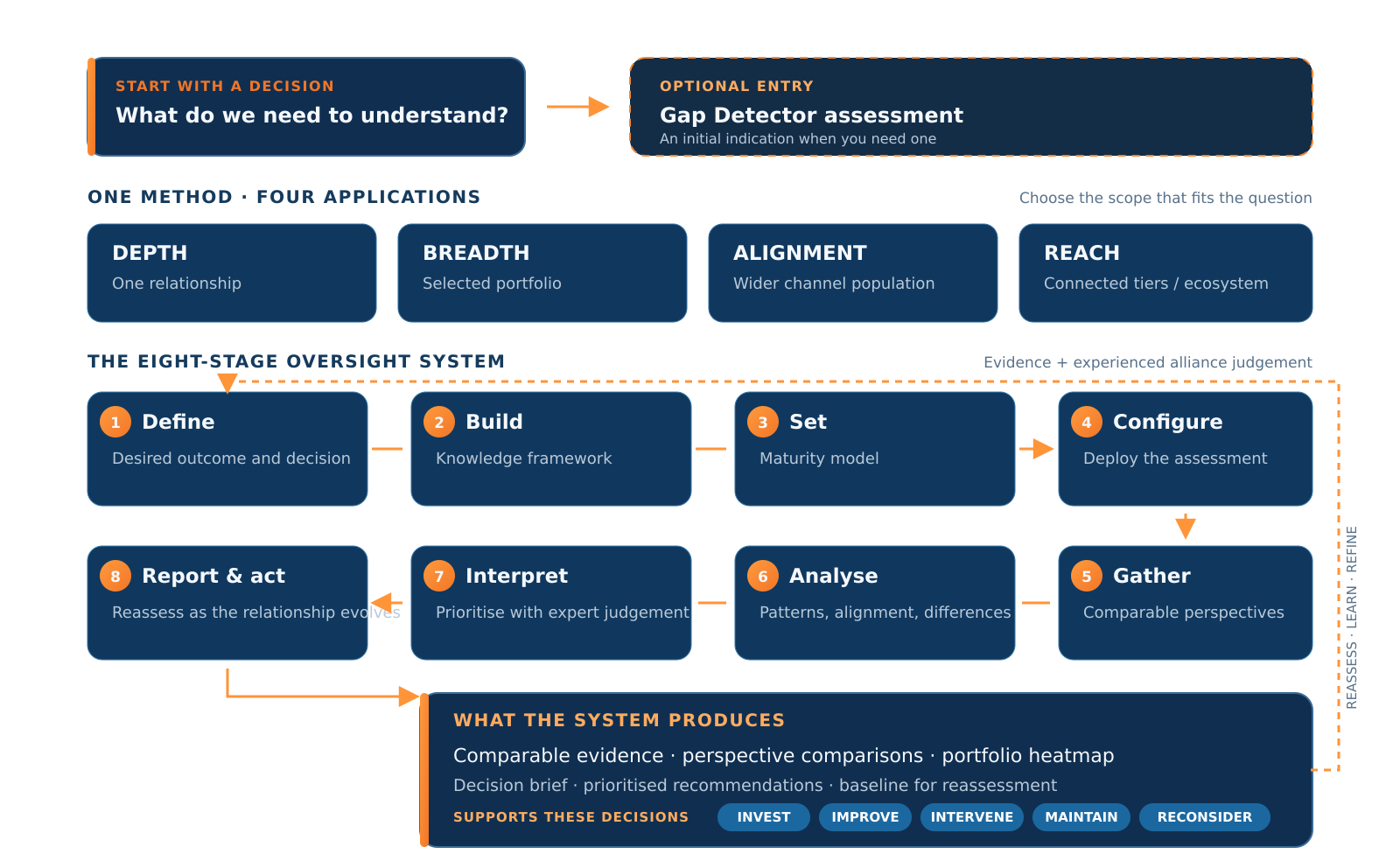
Eight stages, one consistent evidence trail.
Every engagement follows the same eight stages, from agreeing the decision you need to make through to reassessing once you have acted. We work through them together, and each stage builds on the one before, so every finding can be traced back to the evidence behind it and every recommendation to the finding that prompted it. When you need to explain a decision to leadership, the reasoning is already documented.
The first four stages set the foundations: what you need to decide, the standard it is judged against and how it is measured. The last four put that into practice, gathering perspectives, analysing them, agreeing priorities and returning to see what changed.
Define the desired outcome
Specify the decision and outcome the system must support, the partner relationship or portfolio in scope, and the evidence required to inform it. This sets the design requirements for the knowledge framework, maturity model, assessment and reporting.
Build the knowledge framework
Codify the principles of effective partner oversight, the evidence that matters and the criteria used to assess it. This provides the foundation for the maturity model and assessment.
Set the maturity model
Define observable levels of oversight maturity against the framework. This creates a consistent basis for scoring current practice and showing progression.
Configure and deploy the Assessment
Translate the framework and maturity criteria into structured questions, scoring logic and report requirements. Configure the assessment for consistent use across partner relationships.
Gather comparable perspectives
Collect responses from relevant internal and partner participants against the same assessment criteria. This creates a shared evidence base for comparison.
Analyse and benchmark
Use AI-supported analysis to identify patterns, alignment, differences and outliers. Build comparative insight across relationships and over time as evidence accumulates.
Interpret and prioritise
Apply alliance expertise to establish what the findings mean. Translate them into proportionate priorities and clear choices about where to invest, improve, intervene, maintain or reconsider.
Report, act and reassess
Connect findings, recommendations and action pathways in the report and portal. Repeat the assessment to measure change, review the effect of action and strengthen the evidence base.
From a process to a system.
The eight steps are the same every time. What changes from one piece of work to the next is the level at which the assessment runs, whether that is a single relationship, a portfolio or a tier boundary, and whose perspective is included. Those two choices determine which application is used.
A process that repeats in this way needs something to hold it together. The Oversight System does that by keeping the framework, the evidence and the reporting in one connected structure, so each piece of work builds on the last and no step has to be rebuilt from the beginning.
One consistent system, applied to your decision and required outcome.
The Oversight System supports four applications, each addressing a different type of partner decision. All four use the same underlying evidence and perating structure, so the criteria, scoring and reporting behave consistently and the results can be compared and repeated whichever application is used.
Because that structure stays constant while the scope and the perspectives included change, the system is not limited to these four. Where a decision does not fit one of them, the system can be confiured for a bespoke scenario on the same foundation, with the same traceability from the original question through the evidence to the recommendation.
See the position before deciding what to do.
The Oversight System creates a current view of each relationship using consistent criteria. This allows individual relationships to be understood on their own and compared across a wider portfolio.
A heatmap shows where the evidence is well supported, where it may be ageing and where the same issue appears across several partners.
The report explains what those patterns mean. It connects the evidence to the decision, identifies what deserves attention and sets out proportionate recommendations.
Together, they make decisions about time, support and investment easier to make and easier to explain.
Evidence and judgement.
Because every assessment uses the same structure, a finding about one partner can be compared with another, and a reading today can be compared with what follows. Consistency turns separate assessments into a developing body of evidence, which lets the organisation see where relationships are changing, whether interventions are working and whether investment remains aligned with current conditions.
AI-supported analysis identifies differences, recurring themes and outliers across responses and relationships, at a scale that would be slow to do by hand. Experience then establishes why a finding matters, because the same result can carry very different implications depending on the value, purpose, history and dependencies of the relationship. The evidence establishes the position, and judgement connects it to a proportionate response.
Where The Gap Detector Assessment fits.
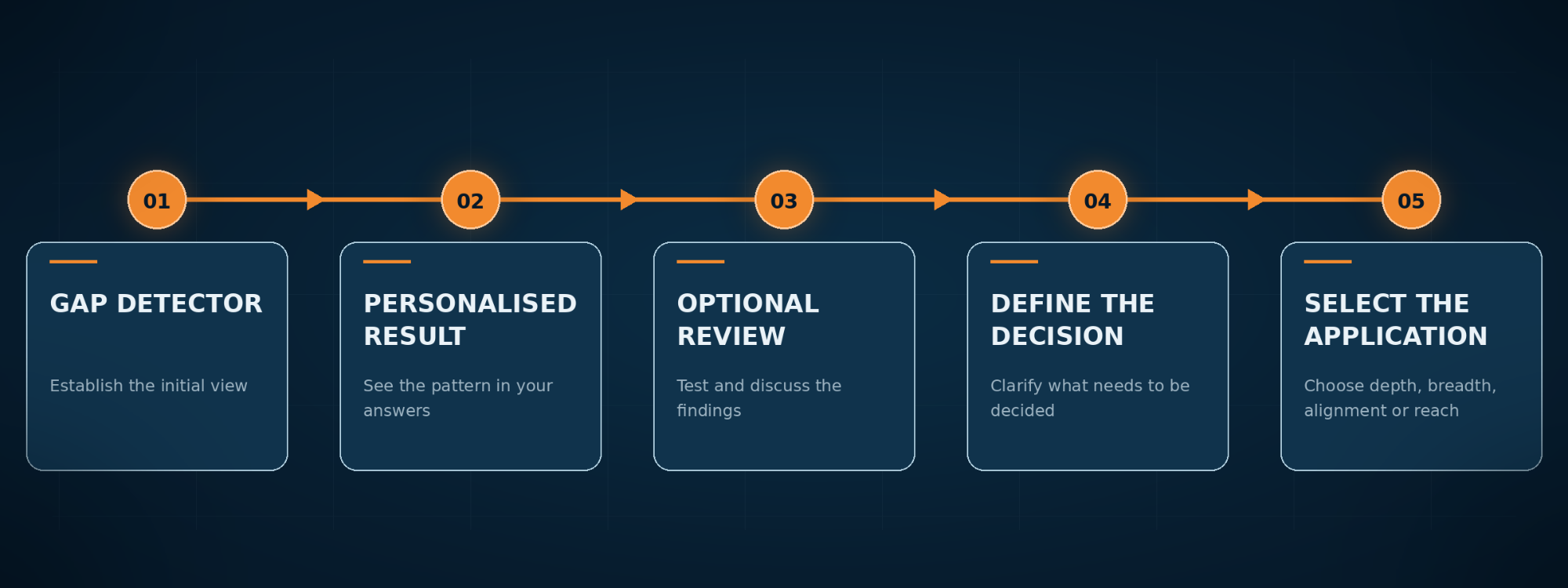
Begin with an indication or start with the decision.
The complimentary Gap Detector provides an initial reading of whether current partner oversight may deserve a closer look.
Where a specific decision, relationship or portfolio question already exists, the engagement can begin by defining that decision and the evidence needed to support it.
The Oversight System provides the structure for everything that follows.
Bring the evidence behind your next partner decision into one clear view.
Every piece of work begins with the decision, relationship or area of uncertainty that prompted the question. It might be an approaching renewal, an investment you are being asked to approve, a partner whose results no longer match what people report, or a portfolio that has outgrown the way it is reviewed.
From there we establish the scope: which relationships are involved, which people on each side need to contribute, and what evidence already exists. That also determines which application of the Oversight System fits, whether a single relationship, a portfolio, both sides of a partnership or a wider ecosystem. The question is recorded at the start, and everything that follows is tied back to it.