PARTNER AND ECOSYSTEM OVERSIGHT
Your partner relationships keep changing. Is your oversight keeping up?
A third-party relationship can evolve faster than the oversight in place to understand it. We create the current, comparable evidence needed to decide where to invest, improve, intervene, maintain or reconsider.
01 Understand the relationship now
02 Compare relevant perspectives
03 Make the next decision
04 Reassess as the relationship changes
WHEN ORGANISATIONS USE US
Usually when an important decision needs a more current view.
The starting point is rarely a request for an assessment. It is a relationship, investment or performance question that the existing evidence cannot answer with enough confidence.
01
An important partner investment is approaching.
02
Similar partners are producing very different results.
03
A strategic relationship has changed significantly.
04
Management, op's teams and the partner hold different views.
05
A channel has grown faster than the oversight around it.
06
A renewal or intervention or decision needs stronger evidence.
HOW THE GAP FORMS
The relationship moves. The oversight stays organised around an earlier version.
Success brings more scope, people, pressure and dependency.
Local adjustments accumulate. Information spreads across teams and systems.
The relationship may still be working while the evidence behind important decisions becomes thinner.
01 The relationship begins
Purpose, responsibilities and expectations are relatively clear.
02 The relationship evolves
Priorities, people, markets and dependencies change.
03 The existing view persists
Reporting and governance continue to reflect what was established.
04 The gap develops
Confidence and current evidence begin to separate.
FOUR APPLICATIONS
One system, applied at the scale of the desired outcome.
The same structured approach can examine a single strategic relationship, compare a selected portfolio, read a larger channel or establish visibility across a layered ecosystem.

Depth
A detailed examination of one important relationship, bringing the relvant evidence and perspectives together to show what is working, what has changed, and what the next decision needs to address.

Breadth
A comparable view across a partner portfolio showing where performance, confidence and exposure differ so investment and intervention can be prioritisied.

Alignment
A structured comparison of how the organisation and its partners see the same relationship, revealing agreement, divergence and the issues that need resolution.

Reach
Oversight extended across channels, tiers and ecosystem relationships, making downstream conditions visible before they affect wider performance.
VISIBILITY AND REPORTING
See the position before deciding what to do.
The Oversight Gap gives a consistent view of each relationship, using the same underlying assessment across every partner. It brings changes, dependencies, ownership, governance and confidence into one place, so patterns are easier to see and priorities are easier to defend.
The example below is illustrative, but the principle is simple: one portfolio, viewed through one standard, with enough context to know where attention is needed.
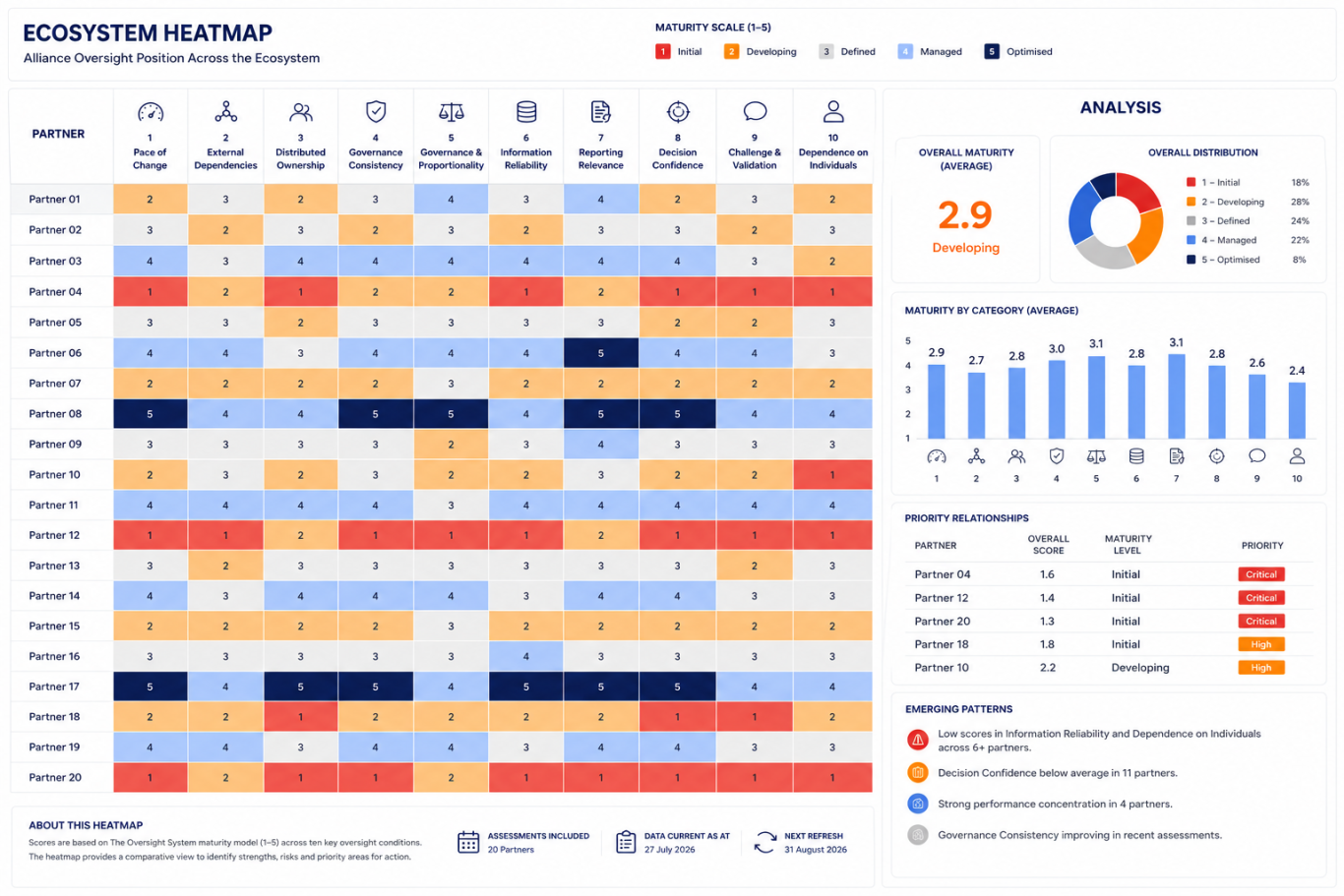
This is not a scorecard for judging relationships in isolation. It is a way to see patterns across the portfolio, using one assessment applied consistently to every partner. The view can help you ask better questions:
- Which relationships need attention first?
- Where is confidence running ahead of evidence?
- Which risks are isolated, and which are appearing across the ecosystem?
- Where should time, support or investment be allocated?
A PRACTICAL FIRST LOOK.
From assessment to a clearer position.
The Gap Detector Assessment provides a focused starting point for organisations that want to test whether their current oversight still reflects the relationship or ecosystem as it operates today.
It brings evidence from across the key areas of oversight into a structured view. The resulting maturity position, category scores and personalised report show where evidence is consistent, where confidence may be unsupported and where there could be something worth a closer look.
The purpose is not simply to produce a score. It is to help determine whether the current approach should be maintained, or whether a more detailed review would provide useful additional evidence.

Gain insight into whether a gap could be forming | Complimentary | No sensitive data required |Report is your to retain.
ILLUSTRATIVE ENGAGEMENT
A large channel, Significant investment, and no comparable view of where it was working.
The organisation had extensive reporting, but no consistent way to compare relationships and decide where support should be concentrated.
What became visible: The assessment revealed material differences between apparently similar partners, including areas where management confidence was not supported by the experience of teams closest to the relationships.
What changed: Investment could be redirected towards the relationships where it had the strongest basis. A six-month reassessment cycle was established to keep the channel view current.
Not sure if there could be something worth a closer look?
Begin with the decision, relationship or area of uncertainty that prompted the question.