VISIBILITY ASSESSMENT
See the whole ecosystem, not just the loudest relationships.
A paid, evidence-based assessment of the structure, performance and maturity of your partner ecosystem.
It brings fragmented information into one comparable view, so decisions rest on evidence and not assumptions.

THE CHALLENGE
Most ecosystems are seen through a few relationships.
Most ecosystems are seen through a few relationships.
As an ecosystem grows, the picture is built from the partners who report most, escalate most, and stay closest to your team. That is not the same as the partners who matter most, or the partners most at risk of drifting.
Four patterns show up again and again:
The loudest relationships define the narrative
Attention goes to the partners who ask most, report most or escalate most, which is not always the same as those who produce most.
Time, funds and training follow the noise instead of the return.
Partners are measured on different terms
Different partner types report in different ways, so there is no like-for-like view of who is contributing what.
Investment cannot be ranked fairly, so comparison falls back on judgement.
Perspectives differ and nobody compares them
Partners, internal teams and leadership each hold their own view of the same relationship, and the differences stay hidden.
Priorities conflict, and the same issue is argued again without being resolved.
Dependence stays hidden
A few partners can carry most of the revenue while the rest of the ecosystem looks healthy.
The exposure shows only when a key partner leaves or changes direction.
Each of these challenges has the same answer: one comparable view of the whole ecosystem, tested against evidence.
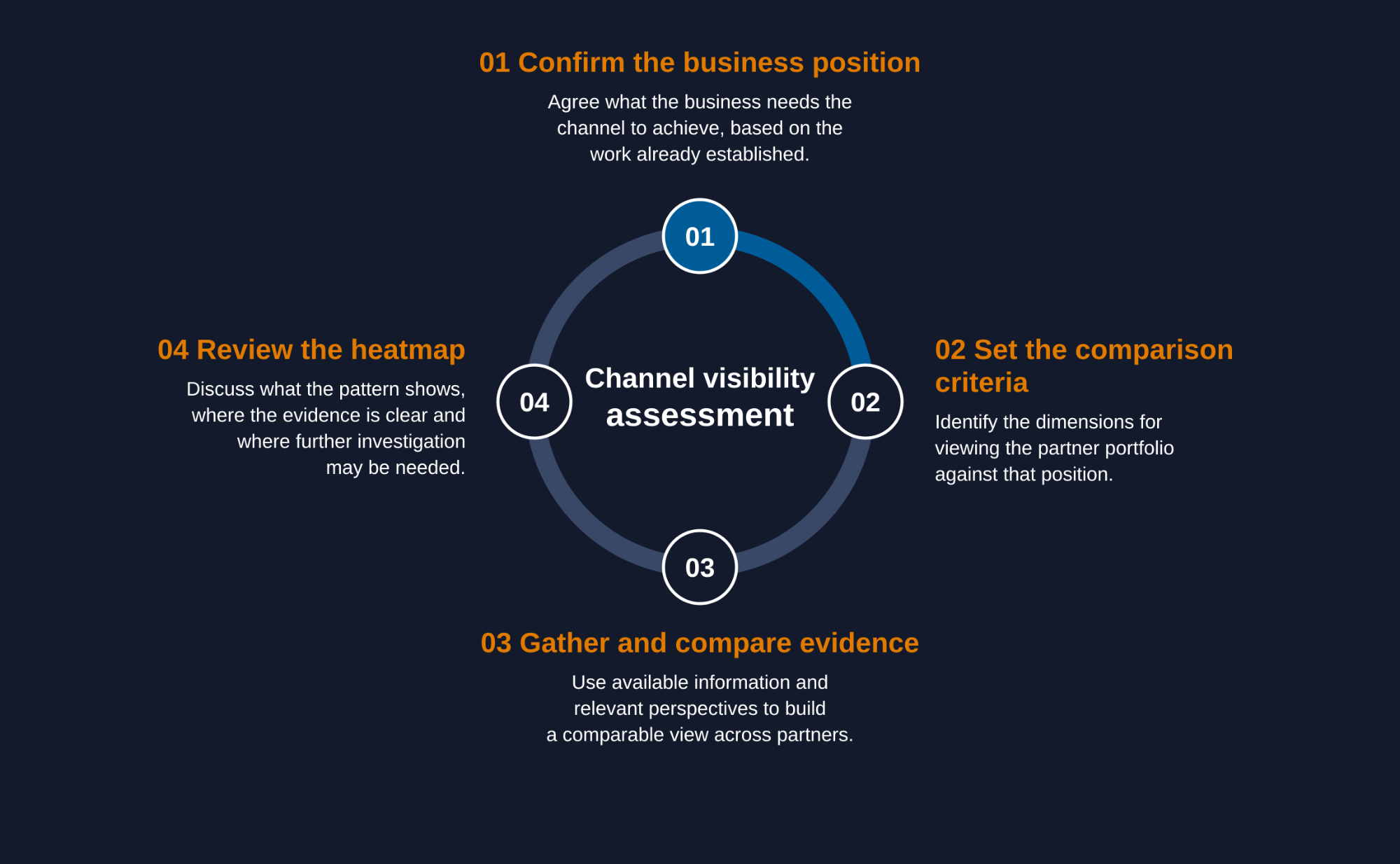
The channel visibility assessment provides it.
HOW THE ASSESSMENT WORKS
From the whole channel down to each partner.
We assess every partner in scope against the same capability criteria, configured around what you need to understand.
Each partner provides its view, then we test it against what can be demonstrated and what shows up in practice. Only what evidence supports counts towards the final maturity position. The result is a channel view you can drill into by region, tier, partner, and capability.
WHAT YOU RECEIVE
One view of the whole channel, with every assessed partner in it.
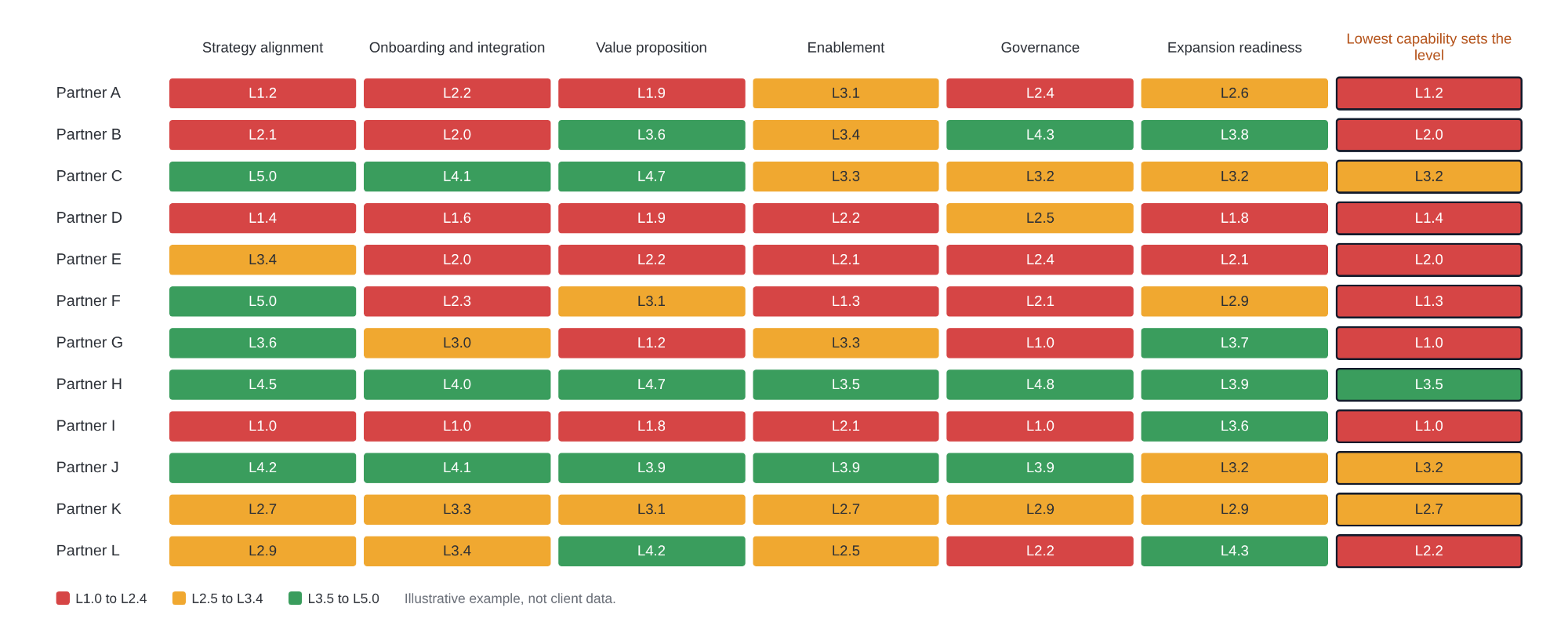
A channel heatmap, backed by evidence.
You get a single page view of the ecosystem, with:
✔️ Each partner’s maturity position,
✔️ The overall ecosystem position
✔️ The capability level that is holding each partner back.
Behind the overview sit the reporting and analytics so you can drill into any region, tier, partner or capability and see:
✔️ Where confidence is higher than the evidence supports,
✔️ Where evidence is missing entirely,
✔️ Where improvement should start to shift the outcome.
ASSESSMENT STRUCTURE
What sits behind each finding?
Each capability on the heatmap is tested using three checks, so the score is traceable and comparable.
01 - Perception
What do people believe is in place?
The people completing the assessment describe how well the capability works.
Their judgment provides a starting point to test against.
02 - Evidence
What can be demonstrated?
Records, completed work and practical examples show which maturity level the capability meets.
They also reveal where a claim still needs checking.
03 - Symptoms
What happens in practice?
Recurring delays, rework or calls for help reveal where a capability breaks down, even when training and processes are in place.
04 - Maturity Score
Which level do the findings support?
Those three checks support a maturity score you can defend, compare, and act on.
Across the ecosystem, the assessment shows where you can direct resources and budget to help partners improve and achieve your growth plan.
WHAT IT REVEALS
The findings that traditional reports cannot show.
Testing every partner's maturity against evidence does more than produce a score. It shows where the channel's picture of itself breaks down: where dependence sits, where claims do not hold up, where evidence is missing and where investment has run ahead of maturity.
Concentration
Most of the channel's maturity sits with a handful of partners, while the rest operate at the entry level and appear healthy only in the reports.
You know where your exposure sits before a key partner moves.
Claims that don't hold up
A partner rates its own pipeline management as strong, but the evidence it supplies shows otherwise.
The difference is settled with evidence, not argued again.
Evidence gaps
Pipeline is reported as committed, but there is nothing to support it.
Forecasts rest on what can be shown, not on what is claimed.
Investment in maturity
Development funds go to partners still at level one in the capabilities that matter most.
Budget follows the maturity needed to put it to work.
QUESTIONS BUYERS ASK
Before you book a call.
Will our partners take part?
Participation is highest when you introduce the assessment as a way to improve the relationship rather than audit it. Each partner also sees its own result against an anonymised average for the channel, which gives it a reason to answer fully.
How long does it take each respondent?
Around 25 minutes. The questions are focused, and evidence can be supplied from material the partner already holds.
Who sees what?
You see the whole channel. If you choose, each partner can see only its own results, no partner sees another partner's results.
How is this different from the data in our partner portal?
Your portal records activity: registrations, pipeline and training completed. This assessment measures maturity, and tests each partner's claims against evidence, which activity data cannot do. Portal data records what partners report. This assessment tests it.
AFTER THE ASSESSMENT
What happens next
In the workshop, we use your heatmap and decision brief ro agree which partners need support, where one action could help several and what needs a closer look. You decide what to implement and who to work with.