THE OVERSIGHT GAP
A relationship can change faster than the oversight used to understand it.
Partners change direction, People move, Priorities shift, and scope grows.
Yet the reporting, governance and assumptions around the relationship often remain organised around what was originally agreed.
WHY IT HAPPENS
The gap often begins with success.
As a relationship becomes more valuable, it also becomes more complex. New stakeholders, responsibilities and workarounds appear. Decisions move closer to the edge and the full picture becomes distributed.
None of this means the relationship has failed. It means the mechanisms used to oversee it have to be recalibrated as the relationship develops.
01
Complexity increases
More scope, stakeholders, dependencies, responsibiliy and commercial pressure enter the relationship.
02
Local reality moves
Teams make sensible adjustments which gradually become the way work is delivered.
03
The formal view lags
Reviews, measures and expectations continue to describe an earlier operating position.
04
The distance goes unmeasured
Nothing is tracking how far the formal view has drifted from how the relationship actually operates, so the gap keeps widening unnoticed.
THE PARTNERSHIP CHALLENGE
No single organisation controls the whole picture.
Third-party relationships create structural visibility problems even when both sides are capable, committed and acting in good faith.
Distributed evidence
Commercial, delivery, finance and partner-facing teams each hold a valid part of the position.
Different definitions of success
The organisations may value revenue, reach, capability, service, influence or strategic access differently.
Shared delivery, separate accountability
Outcomes depend on both sides while reporting and decision rights remain divided.
Lagging measures
Headline measures show what happened, often after the reason for it has become harder to recover.
Informal adaptation
Practical workarounds keep delivery moving but rarely become part of the official operating model.
Uneven rates of change
Partners, markets and business units move at different speeds, making fixed review models less reliable over time.
HOW IT MANIFESTS
The first signs are usually ordinary.
The gap rarely announces itself as a single failure. It appears through small inconsistencies that become normal until a significant decision exposes them.
01
Several credible versions of the relationship exist, but they do not reconcile cleanly.
02
Late surprises appear in delivery, margin, escalation or partner behaviour.
03
Measures still report activity, but explain less about why performance is changing.
04
Accountability is clear in parts and blurred across the full relationship.
05
Decisions rely increasingly on experienced individuals stitching the position together.
06
Escalations get resolved individually, but the pattern behind them never gets reviewed.
WHY IT MATTERS
Confidence remains, but its evidence base becomes less current.
This is a decision quality problem.
Resource may remain committed to the wrong relationships. Performance differences become harder to explain.
Escalations arrive later and management time is spent reconciling versions of reality.
01 Commercial leakage
Value is lost gradually, through terms, pricing or delivery that drift from what was agreed, rather than through any single visible event.
02 Misaligned investment
Time, budget and attention stay committed to relationships based on an out-of-date view of their worth, while others that deserve more get less than they should.
03 Late intervention
By the time a problem is visible enough to act on, the cheaper, earlier window to have caught it has already closed.
04 Unnecessary escalation
Issues that a current, shared picture would have caught early instead surface as disputes, because nobody agreed on the facts before a decision forced the question.
HOW IT GETS CLOSED
Build a current, comparable position.
We define the decision, establish which evidence and perspectives matter, and apply the same questions and criteria across them. Analysis identifies alignment, differences, patterns and outliers. Experienced interpretation establishes what those findings mean in context.
The result is a clearer basis for choosing where to invest, improve, intervene, maintain or reconsider.
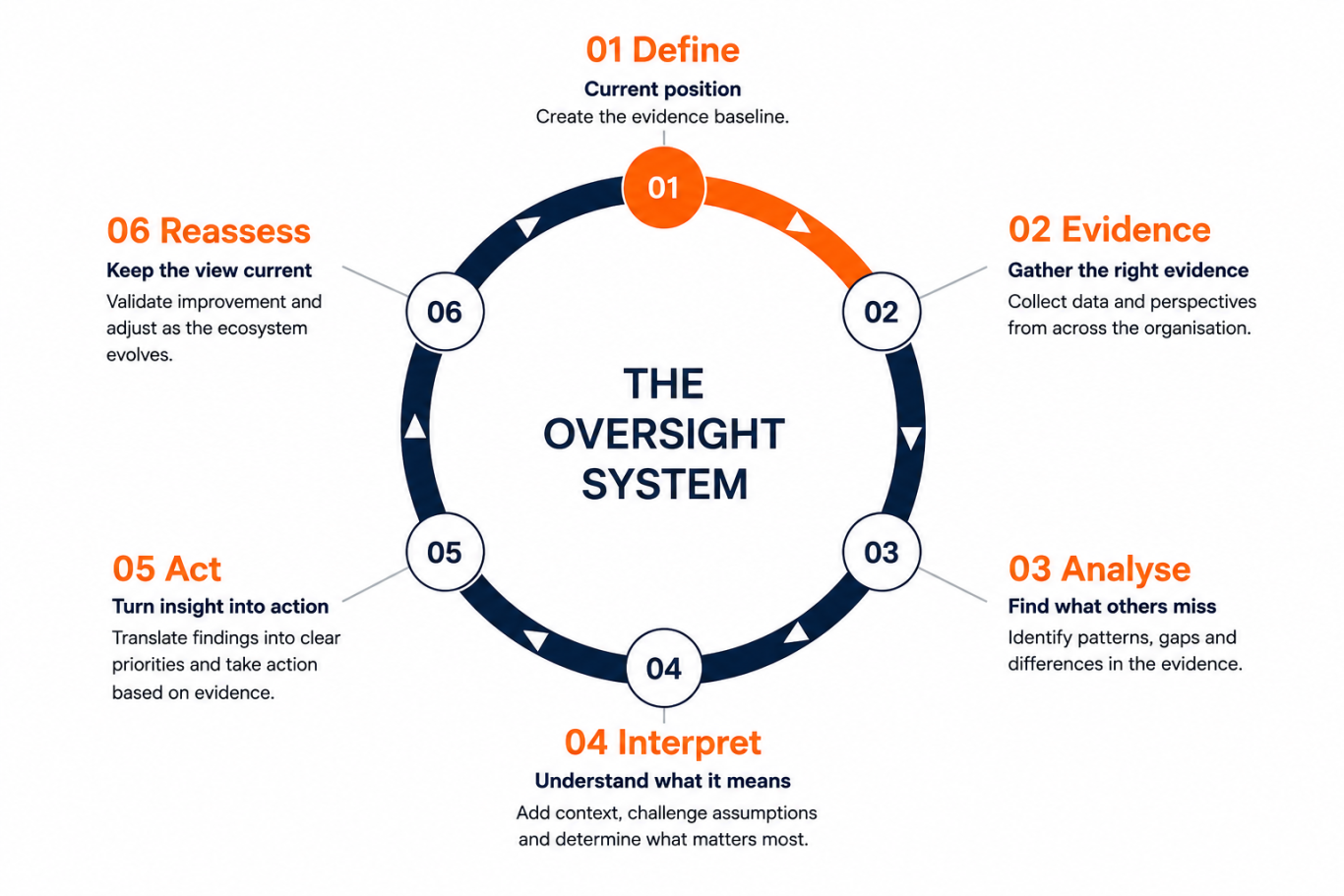
Once a baseline exists, the same framework can be repeated. That shows what changed, whether action worked, where views converged or diverged and whether the original decision remains justified.
This turns a point-in-time reading into oversight and keeps the gap closed.
Not sure if there could be something worth a closer look?
Begin with the decision, relationship or area of uncertainty that prompted the question.