STRATEGY AND DESIGN
Are you designing a channel that can actually deliver?
A paid, evidence-based assessment for a new venture or an existing partner model.
It shows the gap between the intended strategy, operational readiness and the capabilities needed to succeed, before resources are committed. It is set up with you, around your circumstances.
Only 41% of vendors have defined what success looks like and which partner actions drive it.
Source: TSIA, The State of Channel Partnerships 2026

THE CHALLENGE
Most channels are designed around assumptions.
Partner channels are often started because competitors have one, a vendor expects one or a single partner asked. The strategy, economics and organisation behind the decision are rarely tested, so the channel inherits expectations that were never proven.
The decision follows momentum
The channel is started because competitors have one, a vendor expects one or a single partner asked, not because the fit was tested.
Investment begins before anyone knows whether it should.
The economics are assumed
Margins, discounts and the cost of supporting partners are estimated rather than tested against how customers actually buy.
The channel looks viable on paper and loses money in practice.
Partner types are chosen by habit
Resellers, referral partners and alliances are recruited without asking which model suits the offer and the customer.
The wrong partners are recruited, and the right ones are never approached.
The organisation is not ready
Ownership, enablement and governance are left to be worked out once partners are signed or up and running.
Partners arrive to a channel that cannot yet support them.
Each of these challenges has the same answer: a design tested against evidence before resources are committed.
The Strategy & Design assessment provides it.
WHAT YOU WILL SEE
One view of every route you are considering.
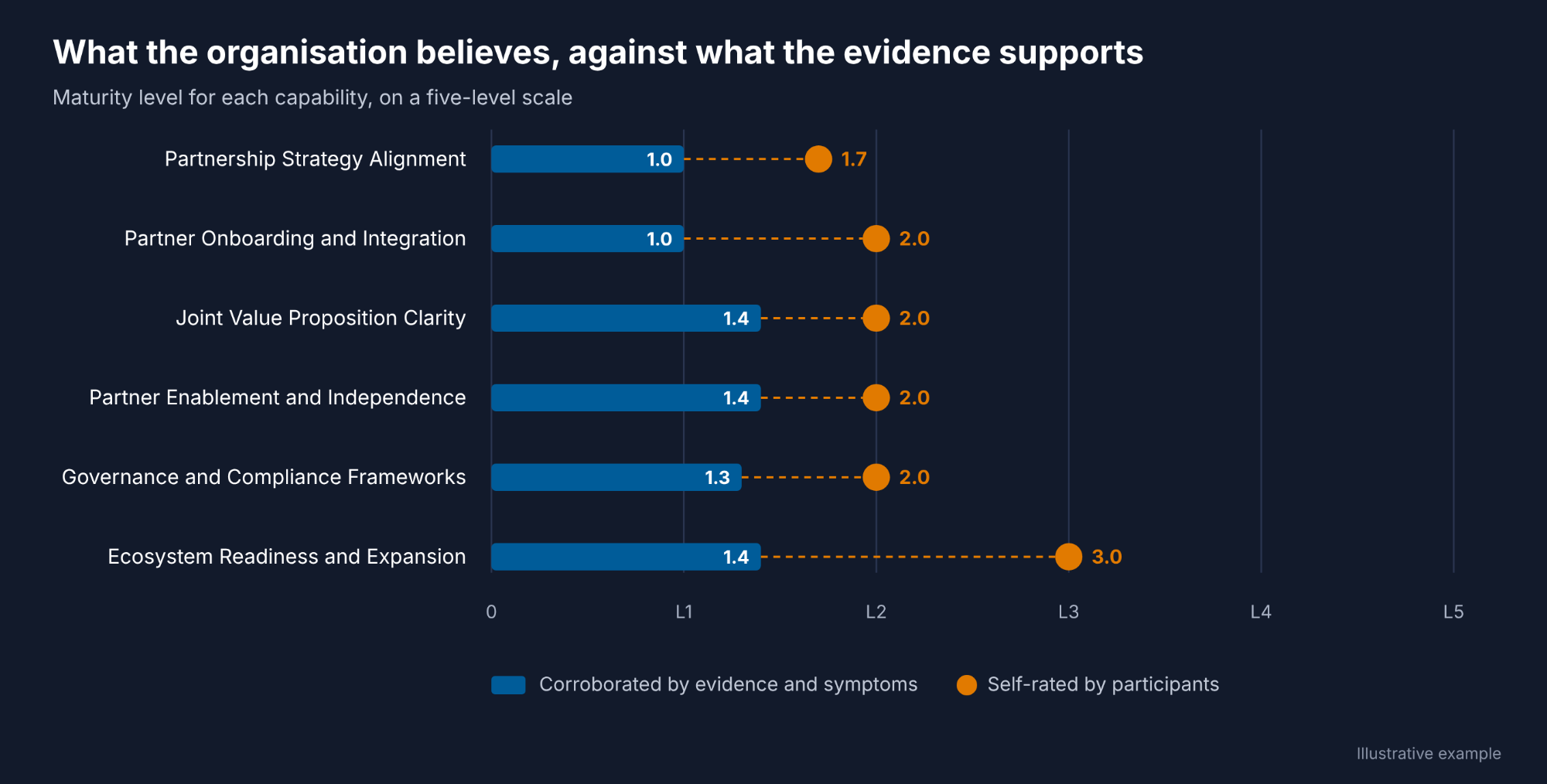
The assessment scores your organisation against the capabilities a partner channel depends on. Each capability is given a maturity level, and your overall level is set by the lowest, so you can see whether the organisation is ready to support a channel and what must be in place first.
Behind the overview sit the reporting and analytics, where you drill into any capability. You see what is holding each one back, how self-assessed views compare with the evidence, and what must change before a channel is built or redesigned.
Every answer first gives a maturity level as the respondent sees it. That level is then tested against the evidence supplied and the problems people report. Only what the evidence supports counts towards the final level, so the score reflects how your organisation actually operates, not how it is described.
WHAT IT REVEALS
The findings reports cannot show.
Testing each route against evidence does more than produce a score. It shows where the case for a channel breaks down: where the fit is weak, where the economics do not hold, where the organisation is not ready and which partner model suits the offer.
Weak fit
The offer is complex and customer-specific, but the plan relies on volume resellers.
You know which routes suit the offer before recruiting starts.
Economics that don't hold
The planned partner margin leaves too little to fund the support partners will need.
Terms are set on evidence, not on estimates.
Readiness gaps
Nobody owns the channel, and enablement and governance have not been designed.
You see what must be in place first.
The right partner model
Referral and alliance partners score well ahead of resale for your offer.
Effort goes to the partner types most likely to succeed.
HOW IT RUNS
From the options on the table to the one that fits.
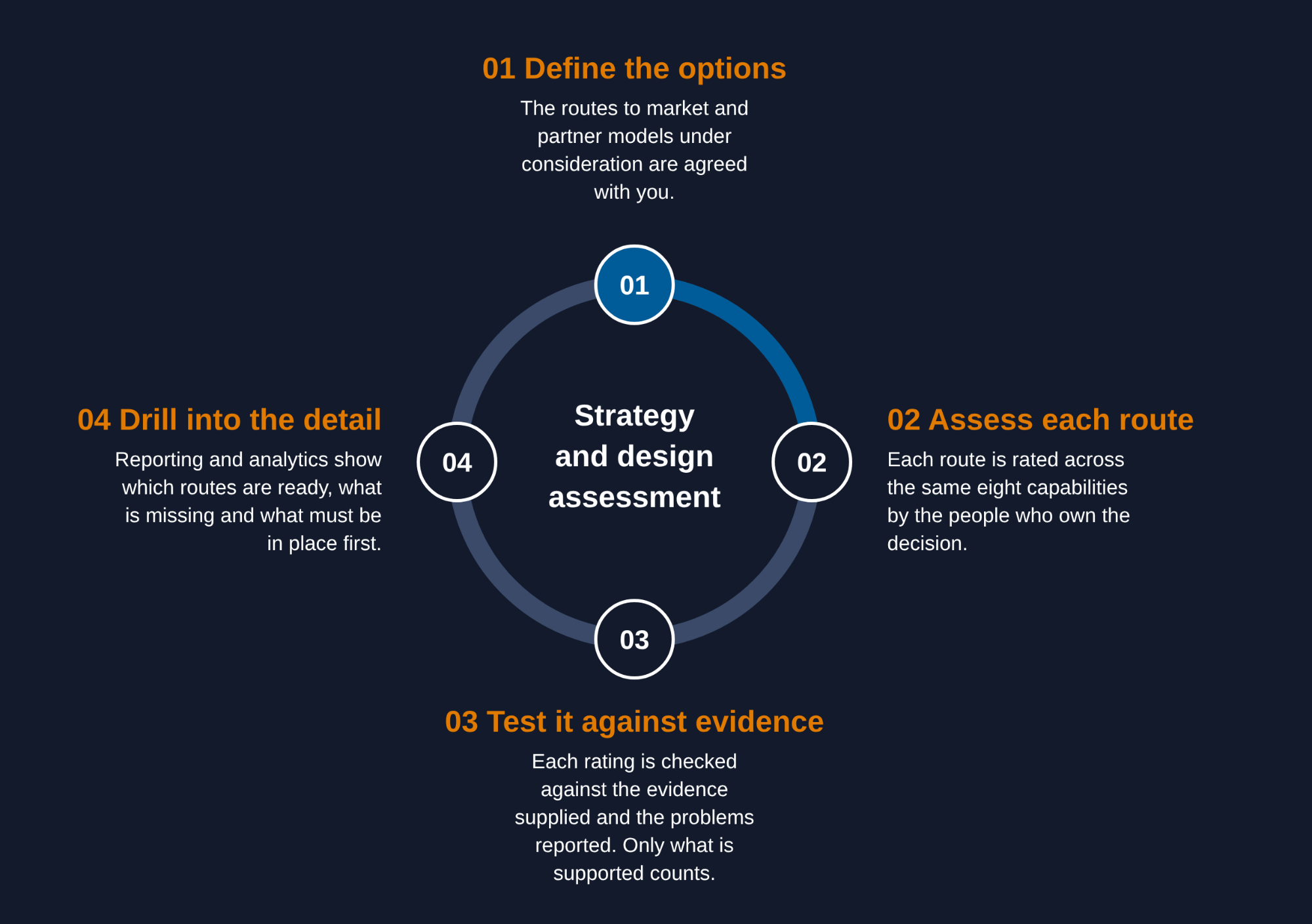
The assessment covers every route to market you are considering, so each is measured on the same basis rather than on preference or precedent.
Each route is rated across eight capabilities. Every rating is then tested against the evidence supplied and the problems reported, so only what can be shown counts towards its level. The results combine into one overview, and the reporting and analytics let you drill into it by route and capability.
IS IT RIGHT FOR YOU?
Is this the right assessment for you?
This assessment looks at whether a partner channel fits before you commit to building or changing it. It is the right place to start if the decision is still open.
You are deciding whether to sell through partners
The case rests on precedent, competitor activity or a single partner's interest.
The decision rests on tested fit, not momentum.
Your existing channel is not delivering
You need to know whether to redesign it, refocus it or step back from it.
You see what must change, and in what order.
You are choosing between partner models
Resale, referral, alliances and marketplaces each look plausible, but which fits capabilities.
You know which model suits your offer and your customers.
Leadership needs a case it can approve
The board wants evidence before committing budget and headcount.
A decision you can defend, with the evidence to show why.
If you already know that one stage of the channel is the problem, one of the other assessments may be the more practical route.
Not sure where to start? Take the free Gap Detector →
SCOPE AND FIRST STAGE
What the first stage involves.
Start with the whole channel or a defined part of it, review the results, then decide whether to extend the assessment. It can be co-funded with a vendor where the visibility serves you both.
Scope
The routes to market and partner models under consideration, or the part of an existing channel being redesigned. The scope is agreed with you before anything is sent, so the results speak to the decision you actually need to make.
The assessment answers the questions you actually face.
Paced by your availability
The assessment runs to a plan agreed with you, but timing depends on when the people involved can respond. You are kept updated throughout, and results are reviewed once enough evidence is in.
No artificial deadline, and no result built on too little, too late.
Outputs
The overview and readiness score, a maturity level for every route assessed and the findings behind them. Each level sets the self-rated position alongside what the evidence supports, and names the capability holding each route back.
A baseline for the channel and for each option.
What we need from you
A named contact to coordinate the assessment, and the people who own the go-to-market decision. Each answers a short set of focused questions and supplies evidence already held.
Little demand on your time or your teams.
QUESTIONS BUYERS ASK
Before you book a call.
Do we need partners in place already?
No. The assessment works whether you are considering a partner channel for the first time or redesigning one you already have. Where partners exist, they can be included.
Who needs to take part?
The people who own the go-to-market decision. The scope agreed at the start sets exactly who that is.
Will it tell us not to build a channel?
If the evidence shows that a partner channel does not fit, the assessment says so. Knowing that before you invest is part of its value.
How is this different from a strategy consultant's recommendation?
A recommendation reflects one person's view. This assessment measures readiness against a defined maturity model and tests every rating against evidence, so the result can be checked and repeated.
NEXT STEP
Know whether the channel will work before you build it.
Book a 30 minute call to discuss your channel and agree the scope for a first phase. If you are not ready to talk, start with the free Gap Detector.