IMPLEMENTATION
Make sure the channel is ready before it launches.
This paid, evidence-based assessment translates an agreed partner strategy into operating capability.
It tests execution readiness, clarifies ownership and avoids committing to a rollout before the foundations are in place, and is set up with you, around your circumstances.
65% of partner and channel leaders do not formally assess their partners’ go-to-market maturity.
Source: The Sherpa Group, 2026 Channel Marketing Survey Report, June 2026

THE CHALLENGE
Most channels launch before their foundations are ready.
Once a channel design is agreed, attention moves quickly to recruiting partners and setting a launch date. The systems, ownership and support the channel will depend on are rarely tested against what the launch requires, so gaps are only found once partners are live.
Execution readiness is assumed
Systems, people and processes are assumed to be ready because the plan says they will be.
Gaps surface in front of partners rather than before them.
Accountability is left open
Decision rights and ownership are expected to settle once the channel is running.
Decisions stall just as the channel needs them most.
Progress is measured by dates
Readiness is judged on milestones met rather than on evidence that the channel is being taken up.
Problems are found only after the launch has passed.
Enablement is not tested
Training, tools and support are built, but nobody checks they are enough for partners to sell.
Partners arrive to a channel they cannot yet work with.
Each of these challenges has the same answer: a tested view of whether the channel is running as designed.
The implementation assessment provides it.
WHAT YOU WILL SEE
One view of every part of the rollout.
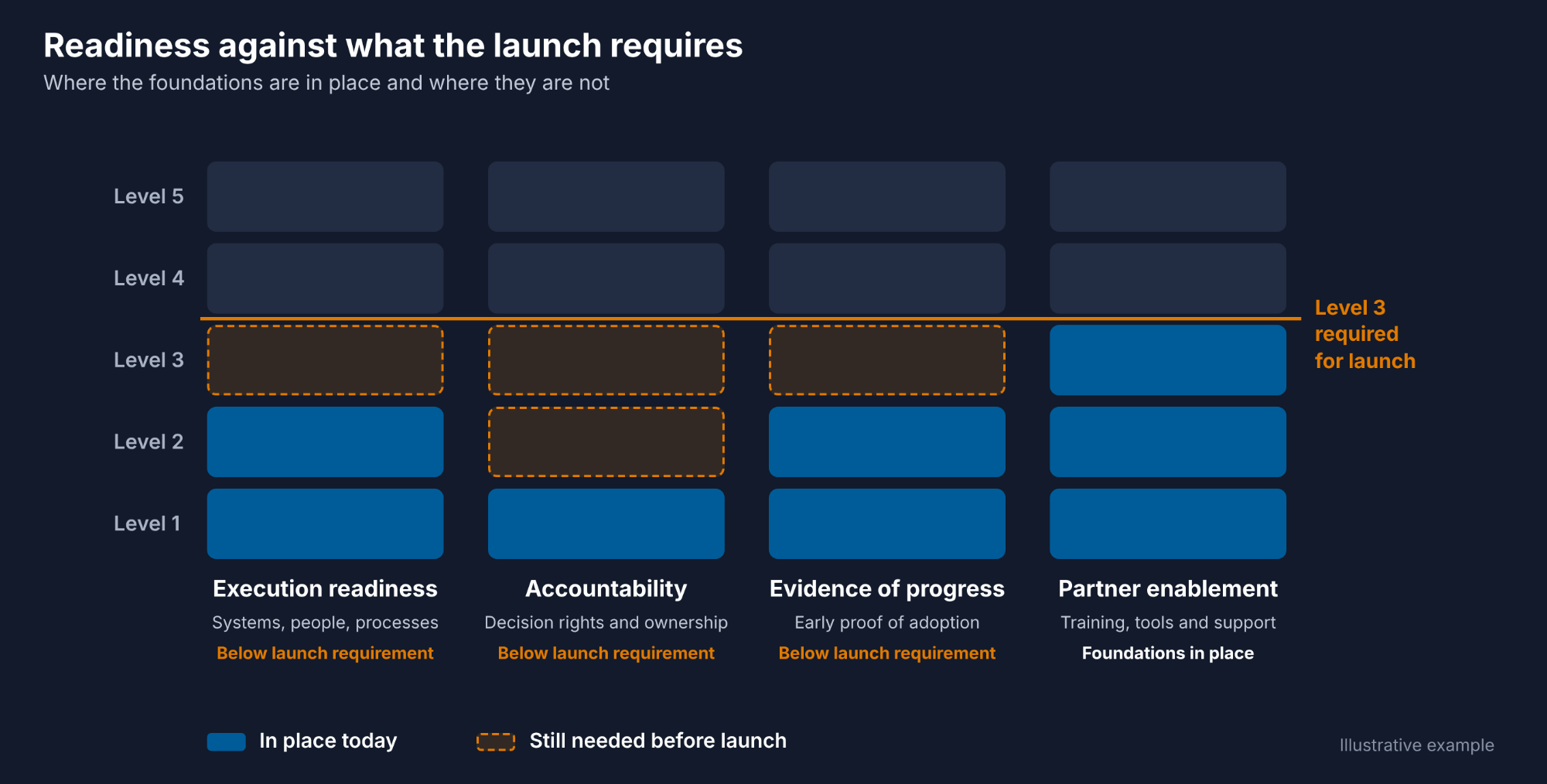
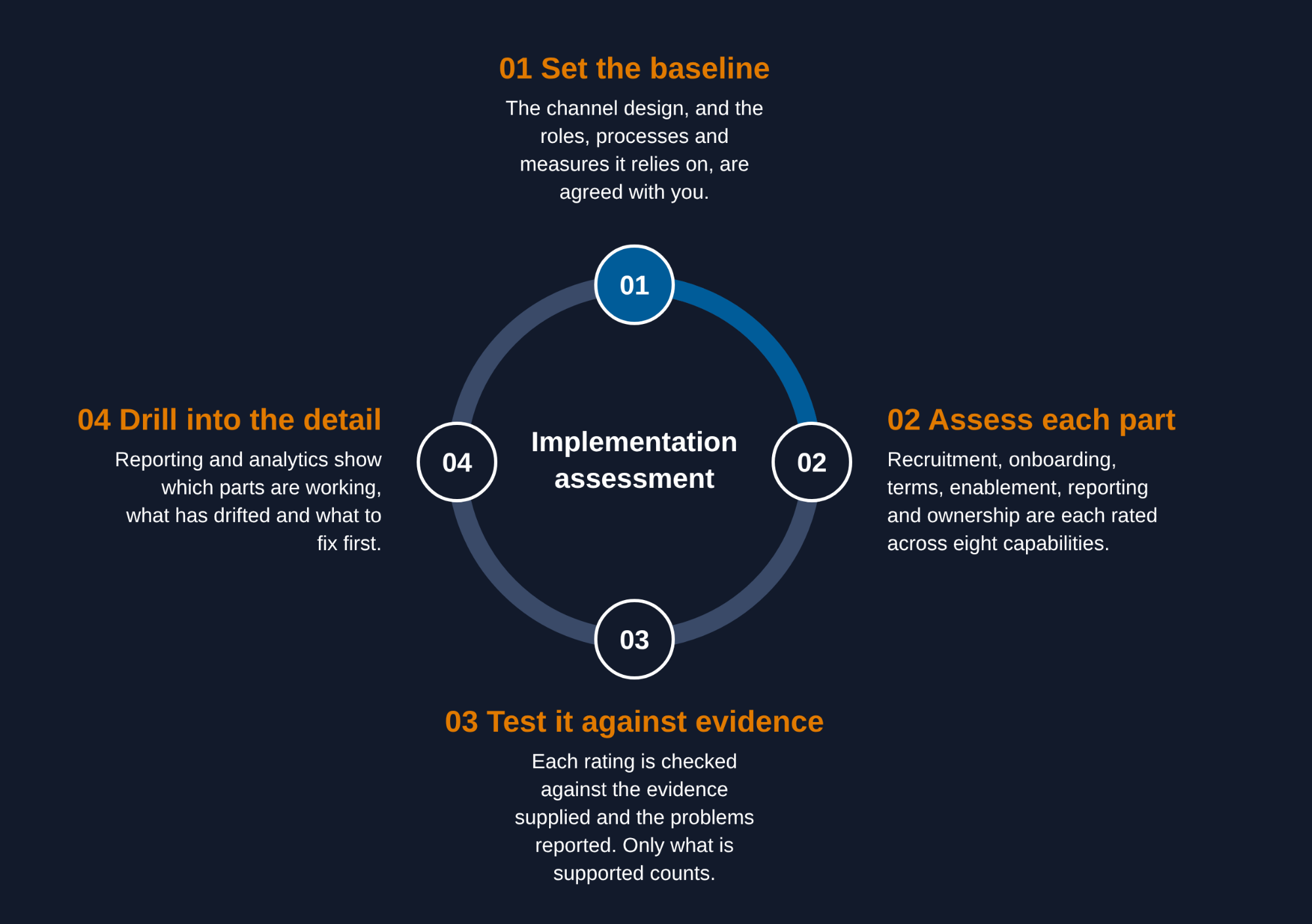
The assessment scores your organisation against the capabilities a partner channel depends on. Each capability is given a maturity level, and your overall level is set by the lowest, so you can see whether the organisation is ready to support a channel and what must be in place first.
Behind the overview sit the reporting and analytics, where you drill into any capability. You see what is holding each one back, how self-assessed views compare with the evidence, and what must change before a channel is built or redesigned.
Every answer first gives a maturity level as the respondent sees it. That level is then tested against the evidence supplied and the problems people report. Only what the evidence supports counts towards the final level, so the score reflects how your organisation actually operates, not how it is described.
WHAT IT REVEALS
The findings your launch plan cannot show.
The assessment shows whether the business is ready to put its channel model into practice. It examines ownership, decision making, partner onboarding, processes, enablement, and the measures needed to manage delivery.
Weak fit
The offer is complex and customer-specific, but the plan relies on volume resellers.
You know which routes suit the offer before recruiting starts.
Economics that don't hold
The planned partner margin leaves too little to fund the support partners will need.
Terms are set on evidence, not on estimates.
Readiness gaps
Nobody owns the channel, and enablement and governance have not been designed.
You see what must be in place first.
The right partner model
Referral and alliance partners score well ahead of resale for your offer.
Effort goes to the partner types most likely to succeed.
HOW IT RUNS
From the options on the table to the one that fits.
The assessment is configured around the implementation outcome. It identifies what needs to be in place, who owns each part and where dependencies could delay delivery.
The resulting pathway sets out the actions and measures needed to put the agreed model into practice.
IS IT RIGHT FOR YOU?
Is this the right assessment for you?
This assessment looks at whether a new or recently changed channel has the foundations it needs to run as designed. It is the right place to start when the design is agreed, partners are being recruited or have just been signed, and the question is whether the systems, ownership and support behind the channel are ready.
You are preparing to launch
The design is agreed and partners are about to be signed. Testing the systems, people and processes first means the channel is ready when partners arrive.
Partners join a channel built to support them.
You want early partners selling sooner
Recruitment is under way and the priority is getting partners to a first sale. The assessment shows which part of onboarding and enablement will make the biggest difference.
Effort goes where it speeds up first results.
You want clear ownership from the start
Sales, marketing and partner management all have a part to play in the rollout. Setting decision rights early keeps the channel moving as it grows.
Everyone knows who owns what, before it matters.
You want to show the rollout is on track
The board has approved the investment and expects more than sign-up numbers as proof of progress. It needs to see whether the channel is delivering results.
A position you can defend, with the evidence to show why.
If you already know that one stage of the channel is the problem, one of the other assessments may be the more practical route.
Not sure where to start? Take the free Gap Detector →
SCOPE AND FIRST STAGE
What the first stage involves.
Start with the launch, or the part of the rollout you want to get right first. The scope is agreed up front, the pace is set by the availability of the people involved, and the results are reviewed with you before the next steps are agreed.
Scope
The whole rollout, or the foundations that matter most to it, such as execution readiness, accountability or partner enablement. The scope is agreed with you before anything is sent, so the results support the decisions you need to make.
The assessment focuses on the foundations your launch depends on.
Paced by your availability
The assessment runs to a plan agreed with you, but timing depends on when the people involved, and any early partners included, can respond. You are kept updated throughout, and results are reviewed once enough evidence is in.
Gaps are found before partners find them.
Outputs
The readiness overview, a maturity level for each foundation assessed and the level the launch requires. Each level sets the self-rated position alongside what the evidence supports, and shows what must be in place next.
A clear view of what is ready and what comes next.
What we need from you
A named contact to coordinate the assessment, and the people who own the go-to-market decision. Each answers a short set of focused questions and supplies evidence already held.
The rollout keeps moving while the assessment runs.
QUESTIONS BUYERS ASK
Before you book a call.
When should we run it?
While the channel is being implemented, before launch. The findings then shape what is put in place, rather than explaining what went wrong afterwards.
Who needs to take part?
The people responsible for implementing the channel. The scope agreed at the start sets exactly who that is.
Do we need a formal channel design to assess against?
No. If the design has not been written down, the assessment establishes what it is meant to be and tests the implementation against that.
How is this different from a project review?
A project review checks whether tasks have been completed. This assessment measures whether the foundations the launch depends on are ready, against a defined maturity model, with every rating tested against evidence.
NEXT STEP
Know whether the channel is running as designed.
Book a 30 minute call to discuss your channel and agree the scope for a first phase. If you are not ready to talk, start with the free Gap Detector.