GROW
Is your channel growing, or just getting bigger?
A paid, evidence-based assessment for a channel that has grown beyond the way it is managed.
It shows where the channel has moved from what was planned, whether partner maturity matches the time, funds and training each partner receives, and where to invest next. It is set up with you, around your circumstances.
Nearly 90% of channel leaders say their ability to measure channel effectiveness still needs improvement.
Source: Channel Marketing Association, 2025 State of Channel Marketing Report, December 2025

THE CHALLENGE
Most channels grow faster than the way they are managed.
A channel grows as partners are added, tiers change and programmes extend. Reporting is rarely rebuilt to match, so it still reflects the expectations set at the start. Nothing appears to have changed, while the channel has.
Reporting describes the plan, not the channel
Reports measure against the expectations set at the start, so they show little change while the partner base, tiers and revenue have moved.
Leadership sees a stable channel that no longer exists.
Activity is mistaken for progress
Registrations, attendance and pipeline counts rise, so the channel appears to be growing. Few of these measure whether partners are capable or committed.
Growth is assumed from activity that may not turn into revenue.
Investment follows habit
Time, funds and training go where they went last year, or to whoever asks, rather than where partner maturity says they will make a difference.
Allocation is hard to defend when leadership asks.
Ownership is stretched
The team that managed a small channel is now managing a larger one, with the same time and the same processes.
Oversight cannot keep up, and the gap widens as the channel grows.
Each of these challenges has the same answer: a current, evidence-based view of the channel as it is now.
The Growth assessment provides it.
WHAT YOU WILL SEE
Where growth stops being supported.
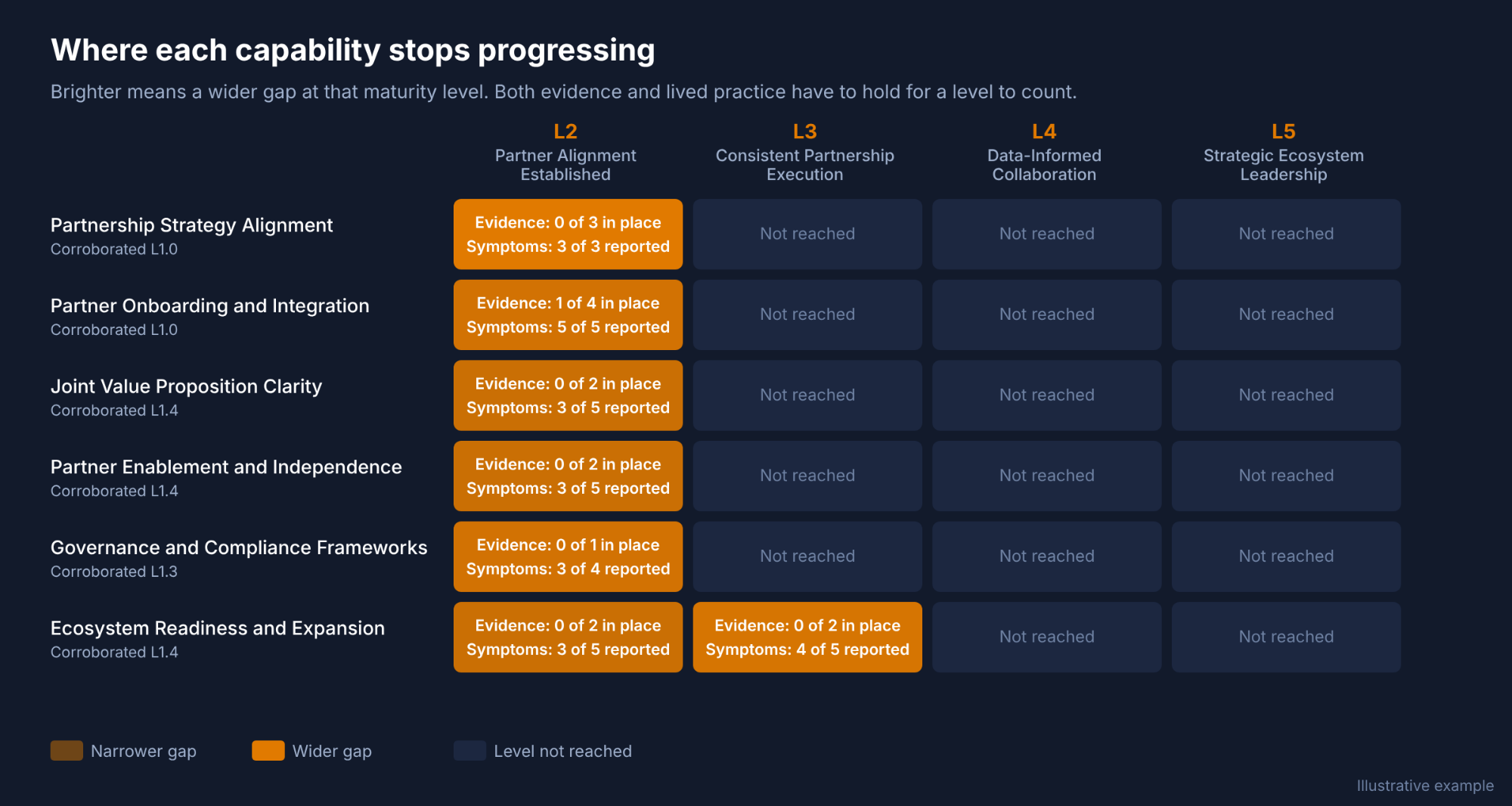
The assessment takes each capability the channel depends on and tests it level by level up the maturity scale. A level counts only when the evidence is in place and the problems it should prevent are no longer reported.
The result shows how far each capability has really reached, and where it stops. The weakest sets the overall level, so it is clear what is holding growth back and what has to be in place first.
Behind the overview, the reporting and analytics let you drill into any capability to see the evidence in place and the problems still being reported.
WHAT IT REVEALS
What growth has changed without anyone noticing.
Testing the channel against evidence does more than produce a score. It shows where growth has outpaced oversight: where the revenue really sits, where maturity and investment no longer match, and what the growth is costing.
Where the revenue really sits
Most revenue comes from a small group of partners, while the wider base is registered but quiet.
You see how exposed the number is to one or two partners.
Where maturity and investment differ
Training and funds have gone to partners whose capability does not yet support them.
Investment moves to where it can make a difference.
How far the forecast holds
Forecast growth is not matched by what partners later deliver, and deals slip or never close.
You know how far the forecast can be relied on.
What growth is costing
Recruitment, support and incentives cost more with each partner added, and the return is not measured.
You see where growth pays back and where it does not.
HOW IT RUNS
From more partners to a position you can defend.
The assessment covers the whole channel or a defined part of it, so every partner group is measured on the same basis rather than on reputation or recent activity.
The results are compared with the plan the channel started with, so the movement is visible. The assessment can be repeated to show whether the position is improving.
IS IT RIGHT FOR YOU?
Is this the right assessment for you?
This assessment looks at a channel that already exists and has grown. It is the right place to start when revenue, cost and confidence in the numbers no longer move together.
The partner count rises, revenue does not
Registrations and activity are up, but revenue is not following.
You see whether partners are capable and committed, or only registered.
Leadership asks where the investment is going
Time, funds and training are allocated, but the reasoning would not survive a challenge.
A position you can show leadership, with the evidence behind it.
A programme review or budget round is coming
Tiers, incentives or funding are about to be reset, and the numbers behind the decision are thin.
Changes made on evidence, not habit.
Costs are rising faster than revenue
Recruitment, support and incentives cost more with each partner added.
You see where spend pays back and where it does not.
If the channel is still being designed or rolled out, or nobody leads it, one of the other assessments may be the more practical route.
Not sure where to start? Take the free Gap Detector →
SCOPE AND FIRST STAGE
What the first stage involves.
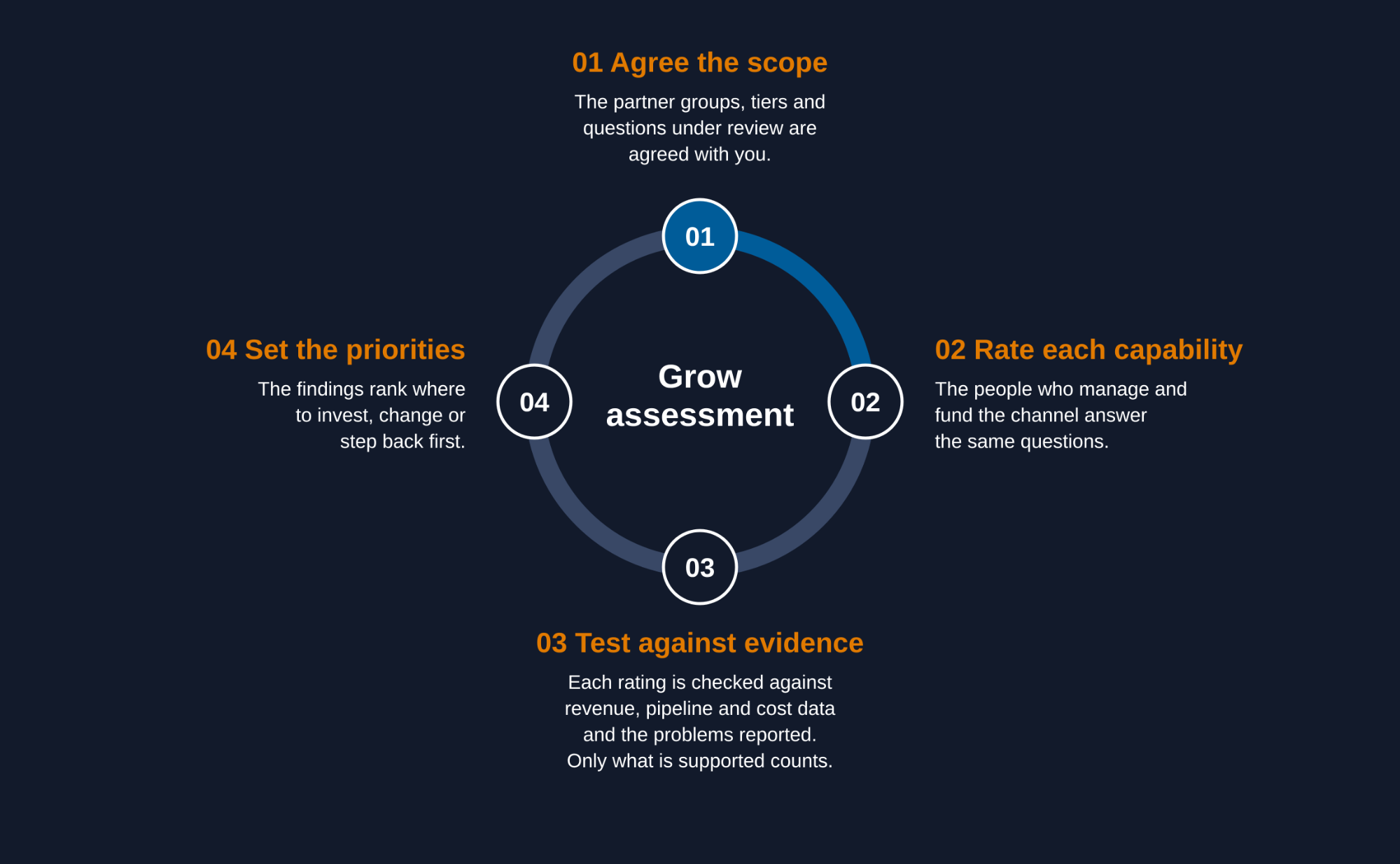
Start with the whole channel or a defined part of it, review the results, then decide what to do next. The scope is agreed before anything starts.
Scope
The partner groups, tiers or regions under review, and the revenue question the assessment has to answer. Agreed with you before anything is sent, so the results speak to the decision that needs making.
The assessment focuses on the foundations your launch depends on.
Paced by your availability
Dates are agreed with the people involved, and results are reviewed once enough evidence is in.
Results built on the evidence, not on a deadline.
Outputs
A maturity level for each capability, the evidence behind it and where the channel has moved from its original plan, with a ranked list of what to address first.
A baseline the channel can be measured against again.
What we need from you
A named contact to coordinate the assessment, and the people who own the go-to-market decision. Each answers a short set of focused questions and supplies evidence already held.
Little demand on your time or your teams.
QUESTIONS BUYERS ASK
Before you book a call.
What data do we need to share?
Whatever already supports the answers, such as programme terms, plans and reports. The scope agreed at the start sets exactly what is needed.
Will it tell us to stop investing in partners?
It shows where partner maturity matches the investment received and where it does not. What to change is for the business to decide.
How is this different from a channel performance review?
A performance review reports results against the targets set at the start. This assessment measures the channel against a defined maturity model and tests every rating against evidence, so it shows where the channel has moved from the plan.
Can it be repeated?
Yes. The assessment can be repeated to show whether the position is improving.
NEXT STEP
Know where the channel really stands before you invest further.
Book a 30 minute call to discuss your channel and agree the scope for a first phase. If you are not ready to talk, start with the free Gap Detector.