PARTNER DECISIONS
Focus your partner investment where it will deliver the greatest return.
Partner relationships rarely stay where they started. Commitment, capability and priorities shift over time, and the internal view of a relationship does not always move at the same pace as the relationship itself.
See where your view of a partner and where that partner actually stands still match, and where they have drifted apart, so every decision about where to invest, improve or step back rests on where things stand now rather than where they stood when the relationship began.
Decisions become harder as the ecosystem grows
Time, budget and management attention are limited, so not every partner can receive the same level of support. As the ecosystem develops, the difficult part is deciding where further investment is justified, which relationships need a different approach and where resources could be used more effectively.
Prioritising the portfolio. Current performance provides an important part of the picture, but it does not always reflect the full value or future potential of a relationship. Strategic alignment, capability, opportunity and the investment required to realise it all need to be considered.
Understanding uneven performance. Partners receiving similar levels of support can produce very different results. Looking beyond the numbers can help establish whether the difference is being driven by alignment, engagement, capability, internal ownership or the underlying opportunity.
Reviewing an important relationship. A partner may be missing targets, changing direction or attracting greater competitive attention. Before deciding how to respond, leadership needs to understand whether the issue is temporary, operational or evidence of a more significant change in the relationship.
Responding to a change in strategy. New leadership, a new market or a different operating model can alter what the organisation needs from its partners. Relationships established around the previous strategy may still be valuable, but their role and the resources committed to them need to be considered against the priorities that now matter.

None of these situations means that existing reporting or partner management has failed. They create a need to consider the available information in a broader context, bringing together what the numbers show with the knowledge held across leadership, internal teams and the partners themselves.
The issue is rarely whether information exists. It is whether the relevant evidence and perspectives can be brought together clearly enough to support the decision that needs to be made.
The evidence rarely sits in one place
Most organisations already have reporting, account plans, partner reviews and experienced people managing key relationships. Each provides an important part of the picture.
Performance data shows what has happened, internal teams understand the day-to-day relationship, leadership sets the commercial and strategic priorities, and partners have their own view of the opportunity, the engagement and what needs to happen next.
The challenge is bringing those sources together on a consistent basis, so that important decisions are not shaped by one report, one relationship or one point of view.
Turn a broader view into better decisions
When evidence from across the ecosystem is considered together, it becomes easier to distinguish between relationships that need greater investment, those that need improvement and those that may no longer justify the resources committed to them.
It also provides a stronger basis for understanding why performance varies, where different stakeholders are aligned and where a change in approach could produce a better outcome.
Focus investment by directing resources towards the partners, capabilities and opportunities with the strongest case for further development. Improve alignment by identifying where leadership, internal teams and partners are working from different expectations or priorities. Act earlier by recognising changes in commitment, capability, opportunity or strategic direction before they materially affect performance. Use resources more effectively by reducing activity that is unlikely to deliver sufficient value and redirecting it where it can make a greater difference.
Evidence creates choice
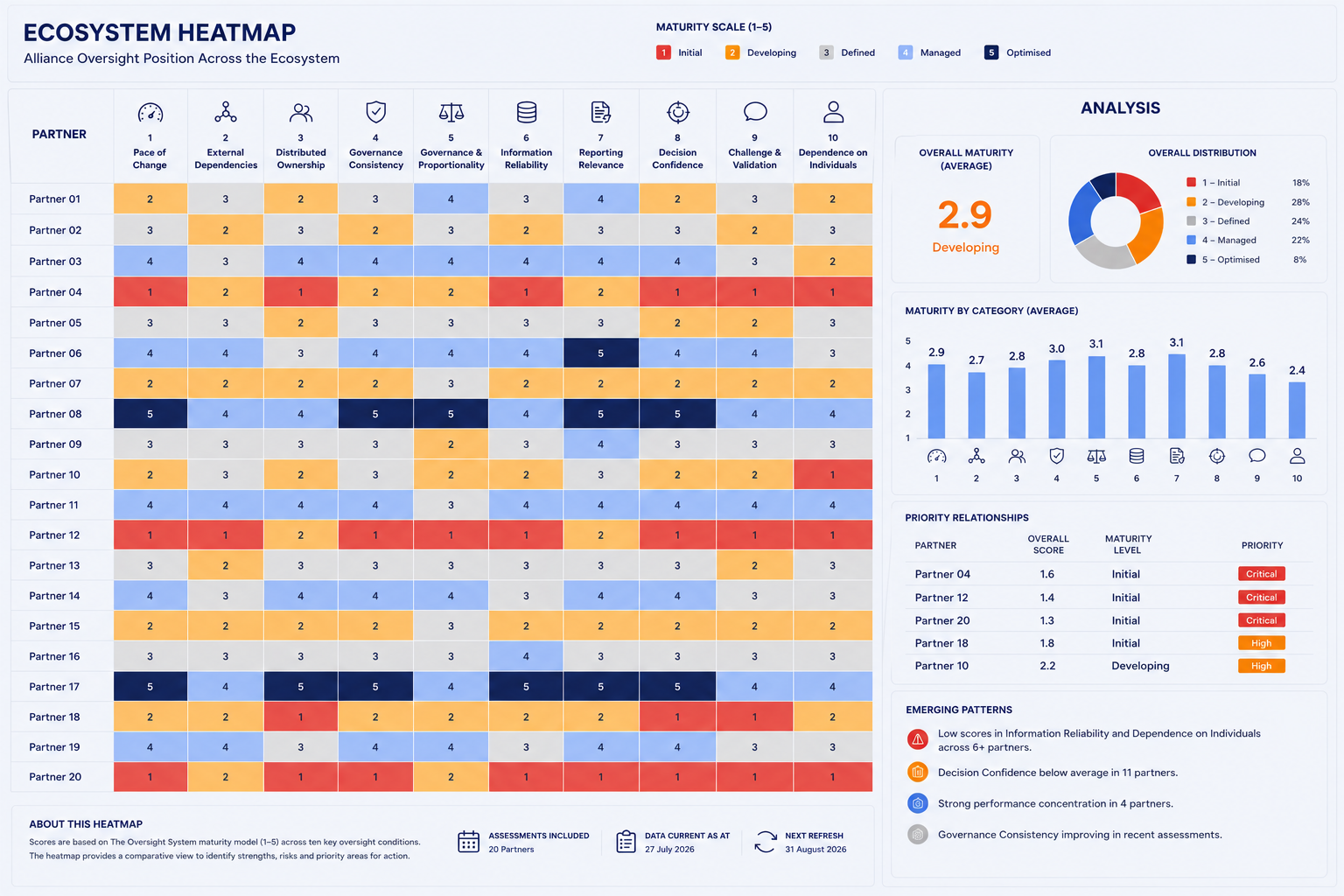
Bringing the available evidence and perspectives together creates a common basis for considering the ecosystem as a whole. It allows management to compare relationships consistently, understand why performance varies and distinguish between issues that require action and those that do not.
That matters because greater visibility should not automatically lead to more activity. Its value lies in helping leadership act selectively, focusing time, investment and management attention where they are most likely to improve the outcome.
The evidence shows where attention is justified. The next step is deciding what each relationship requires.
Different relationships require different decisions
No two partner relationships require exactly the same response. A relationship with unrealised potential needs a different approach from one that has lost strategic relevance, while a relationship performing as expected may need no change at all.

Invest
See which partners genuinely have the alignment, capability and potential to earn more, and put the investment behind them before someone else does.
Improve
See the specific barrier behind uneven performance, the one a dashboard never shows, and fix it before a valuable relationship keeps underperforming for no good reason.
Intervene
Catch misalignment or fading commitment while there's still time to act, instead of finding out only when the relationship is already lost, and communication has ended.
Maintain
Confirm, rather than assume, that a relationship still deserves its current level of support, so nothing you've stopped watching quietly drifts.
Reconsider
See exactly which activity has stopped earning its place, and stop funding it before the wasted budget grows any larger, and third party funding is reduced.
Reassess
Come back to the same evidence on a schedule, so no decision is ever again made on a picture of the relationship that stopped being true months ago.
Comparison needs a common basis
Different relationships may require different responses, but the decisions still need to be founded on evidence that can be compared. If every partner is considered through different questions, criteria or expectations, it becomes difficult to know whether the differences reflect the relationship or the way it was examined.
A common framework provides a consistent basis for comparing alignment, capability, engagement, opportunity and performance across the ecosystem. It allows patterns and outliers to be identified without losing the context of each individual relationship.
That consistency also makes the process repeatable, allowing the same evidence to be developed across more partners and revisited over time.
The Visibilty Assessment
Developed for decisions that cross the ecosystem
Partner reporting, account plans and relationship reviews are generally designed to manage individual partners and monitor current performance. They remain essential, but leadership decisions often extend beyond one relationship. They require partners, opportunities, capabilities and priorities to be considered together.
The Visibility Assessment was developed for those decisions. It brings existing information together with the perspectives held across leadership, internal teams and partners, using a common framework shaped around the question the organisation is trying to answer.
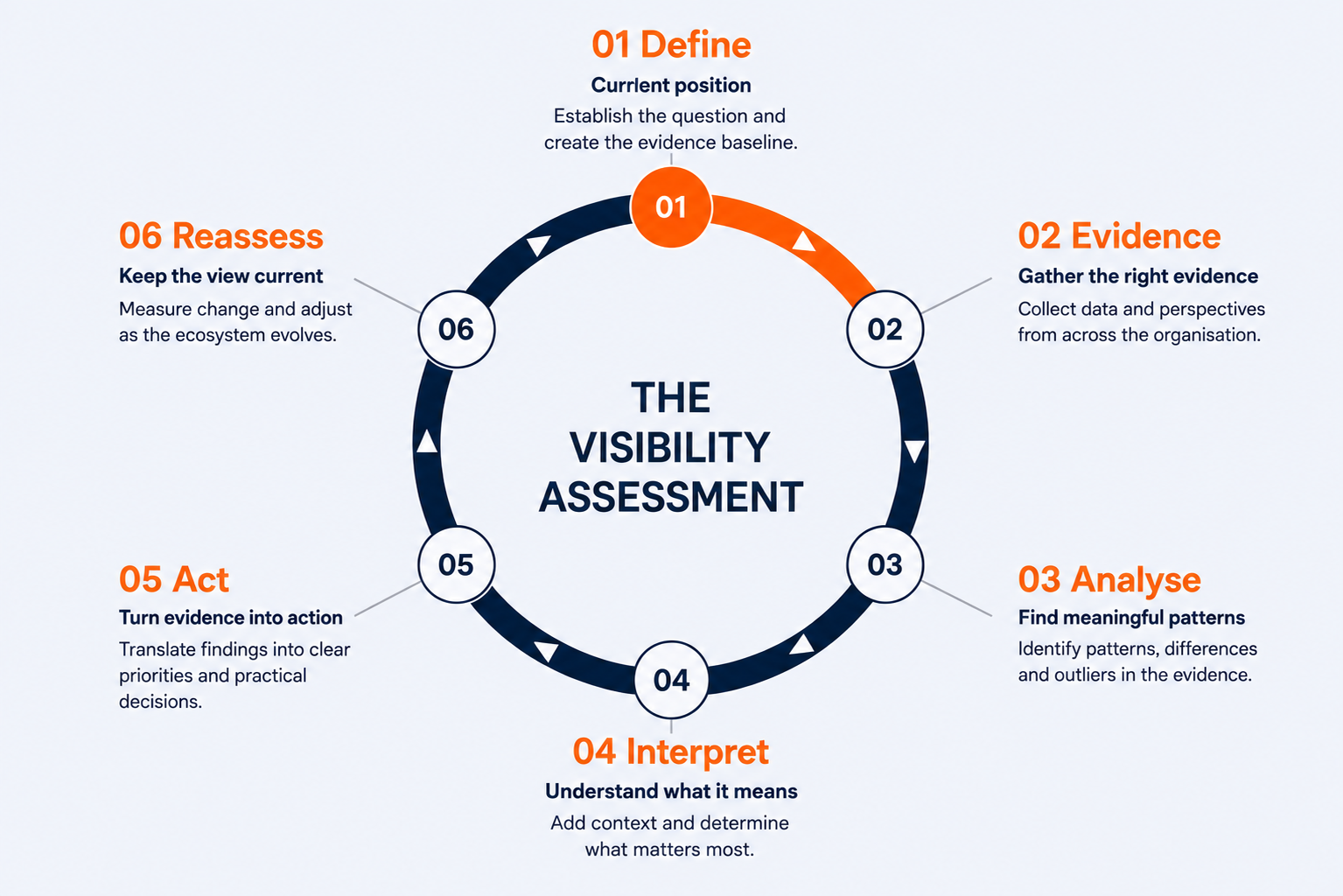
This creates evidence that can be compared across selected relationships or an entire ecosystem without losing the context that makes each partner different. It can show where perspectives align, where material differences exist and which patterns only become visible when the portfolio is considered as a whole.
AI-supported analysis makes it possible to examine that evidence at scale, while experienced judgement is used to interpret what the findings mean and translate them into practical decisions and improvement pathways.
Because the approach is standardised and systemised, it can be repeated across more partners and revisited over time. This provides a consistent baseline for measuring change, testing whether action has worked and keeping future decisions aligned with how the ecosystem continues to develop.
Decision-led. Multi-perspective. Scalable. Repeatable.
The value lies in what happens next
The Visibility Assessment creates a consistent view of the ecosystem, but producing more information is not the objective. Its value lies in helping leadership decide where attention, investment and change are most likely to improve the outcome.
Once relationships can be considered on a comparable basis, it becomes easier to distinguish between partners that support the organisation’s priorities, those that could deliver more with focused improvement and those where continued investment may no longer be justified.
The findings provide both a basis for action and a baseline against which the effect of those decisions can be measured. The following anonymised engagement shows how that works in practice.
What this looks like in practice
An anonymised client engagement
A technology distributor managed a broad channel of resellers, solution providers and managed service providers. Leadership had access to performance reporting and experienced teams managing the relationships, but needed a broader view before deciding where limited resources and management attention would produce the greatest return.
The decision
The organisation needed to determine which partners warranted further investment, where a different approach could improve performance and where continued support was unlikely to deliver sufficient value.
What was examined
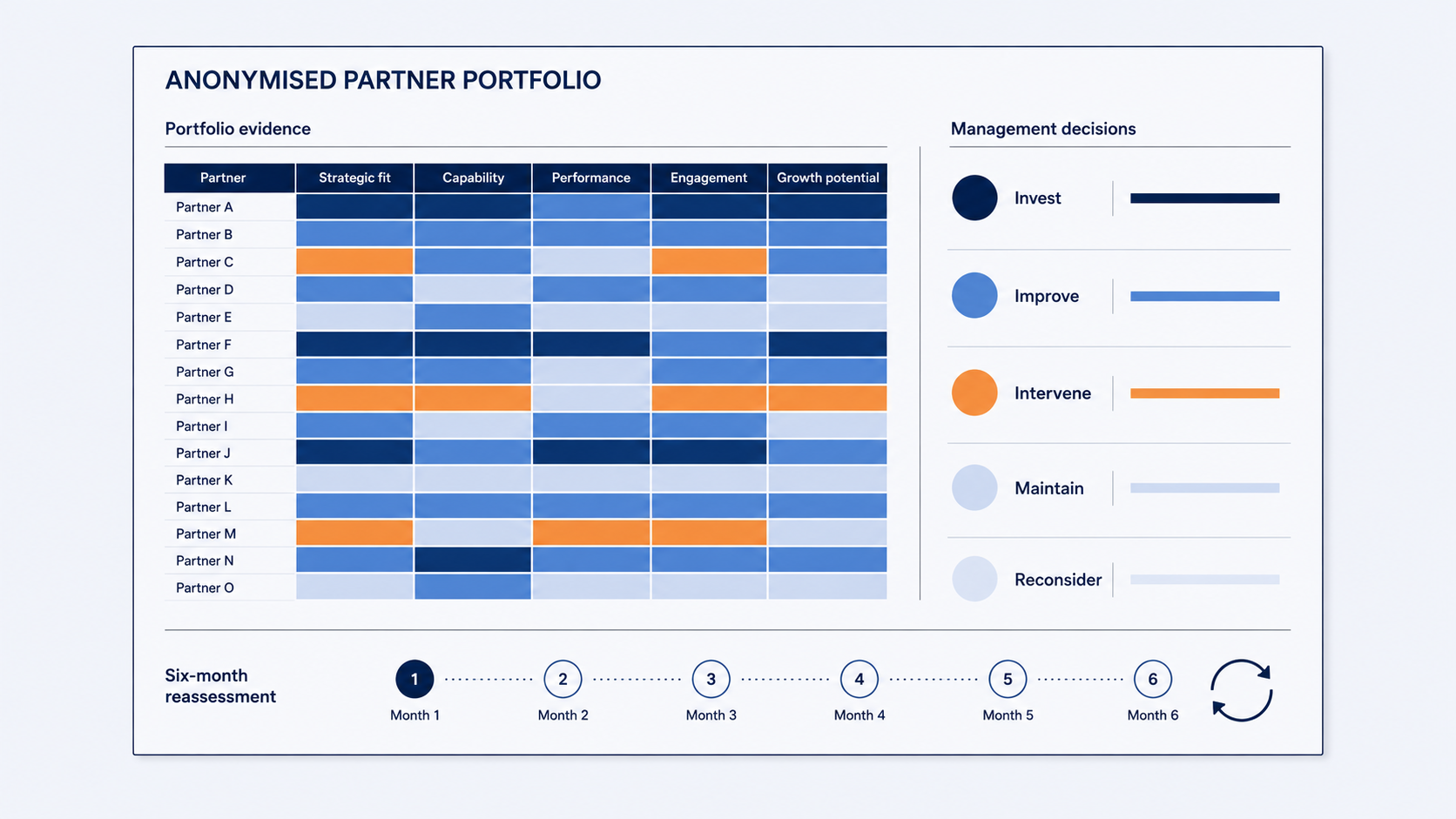
The channel was considered as a portfolio using consistent criteria across strategic alignment, engagement, capability, opportunity and current performance. Evidence from existing reporting was brought together with the knowledge and perspectives held across the organisation.
What became clearer
The resulting portfolio view showed where alignment and commercial potential were strongest, which relationships had underused capability and where the resources being committed were no longer proportionate to the likely return.
Leadership could then distinguish between partners that justified greater investment, those requiring focused improvement and those whose level of support needed to be reconsidered. The assessment also established a baseline that could be revisited every six months to measure movement and evaluate whether the decisions taken had produced the intended result.
What partner decision are you trying to make?
Whether the question concerns an entire channel, a group of partners or one strategically important relationship, the starting point is the decision that needs to be made.
A short conversation can establish what you need to understand, what evidence is already available and whether a broader view would provide a stronger basis for deciding what happens next. You do not need to define the scope of an assessment before getting in touch.
If you are not yet ready to discuss a specific decision, the complimentary check provides an initial view of how consistently partner evidence is gathered, compared and used across your organisation.