
Why is performance uneven?
Performance reporting can show that one relationship is producing more than another. It cannot always explain whether the difference is caused by market opportunity, strategic fit, partner capability, internal ownership, mutual commitment or the way the relationship is being managed.
The Visibility Assessment looks beyond the result to examine the conditions producing it. This makes it possible to distinguish a performance issue that can be addressed from a relationship whose current result reflects a more fundamental constraint.
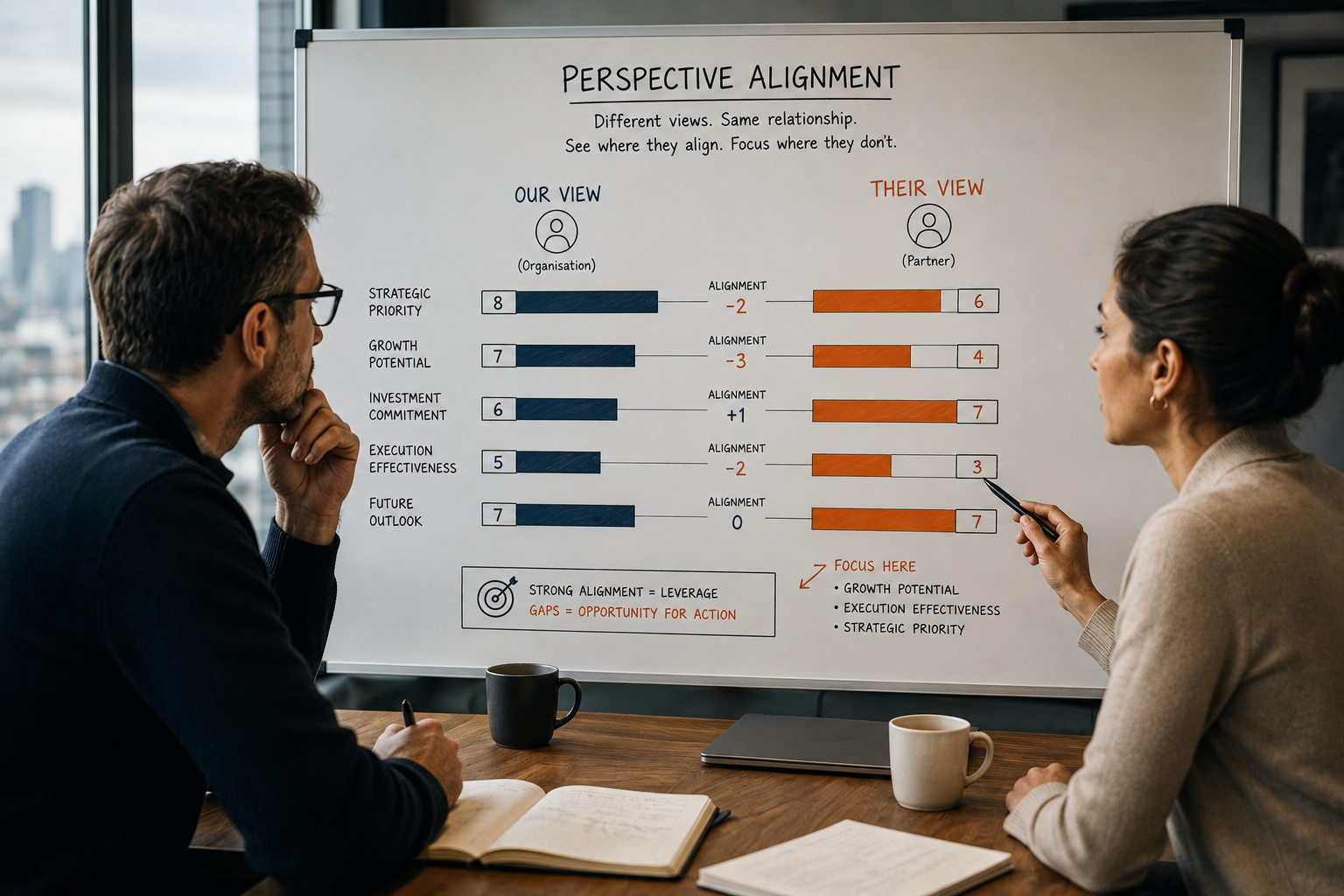
Similar results can have very different causes
Two partners may report the same shortfall while requiring completely different responses. One may have the right capability but lack access to the people, information or support needed to progress. Another may be well supported but no longer regard the relationship as a priority. A third may be operating effectively in a market where the available opportunity is simply smaller than expected.
Treating all three as a general performance problem risks adding activity without changing the underlying position.
Compare the conditions behind the result
The assessment combines relevant performance data with the perspectives of the people closest to the relationships. It examines the intended role of each partner, the opportunity available, the capability to pursue it, the commitments on both sides and the effectiveness of ownership, governance and execution.
Applying the same framework across stronger and weaker relationships shows what is different between them. Looking across the wider group also reveals whether a constraint belongs to one partner or recurs across the portfolio, pointing to an internal process, support or management issue that individual reviews may not expose.
Move from explanation to intervention
Leadership gains a reasoned explanation for the variation rather than another description of it. The findings show which relationships could improve through focused support, where expectations or responsibilities need to be reset and where current performance is unlikely to change without a more substantial shift in strategy or commitment.
This allows intervention to be directed at the cause. Resources can be concentrated on the relationships that can respond, while activity that is unlikely to affect the result can be reduced or reconsidered.
Move from a performance gap to a specific decision
If partner results vary and the reason is not clear, the starting point is to define which relationships should be compared and what a better outcome would need to look like.