The Baseline Assessment.
A personalised assessment across ten categories, scored against a five-level maturity model, and a 60-minute session to walk through what it found.
The free Self-Assessment tells you whether a gap could exist. The Baseline Assessment tells you where, built from your own governance history, scored against our framework, and returned as a complete picture of how your alliances are actually being overseen, not just how they're performing.
It covers ten categories, from how well you're tracking change in your alliance environment, to how far leadership's confidence is actually matched by evidence. Each is scored from Historical and Assumption-Led through to Integrated and Routinely Validated, then walked through with you directly in a 60-minute results and analysis session.
- Fixed fee: £2,495
- Up to five leadership respondents
- Tailored executive report
- 60-minute findings session
- Defined next-step options
Baseline Assessment Areas
Multiple conditions, one consistent maturity model delivers a clear view of where oversight is trusted, and where it isn't.
Multiple conditions, one consistent maturity model, delivering a clear view of where oversight is trusted, and where it isn't.
The Baseline Assessment is the structured starting point within the Oversight System.
The core system already exists: the assessment process, maturity model, evidence structure, reporting engine and leadership comparison. It's then configured around your organisation's own alliance context, priorities, terminology and existing intellectual property, so the assessment reflects how your alliance environment actually operates, not a generic template.
It doesn't assume a gap exists, and it doesn't audit partner performance. It assesses whether the conditions are present that could leave leadership relying on outdated, incomplete or fragmented oversight.
The output is a clear baseline position, supported by a configured maturity model, comparison across leadership respondents, and defined next-step options where further investigation is justified.
Pace of Change
Whether oversight keeps pace with changes in partners, priorities, markets, leadership and operating models.
External Dependencies
Whether the organisation understands the partner, market and third-party dependencies that may affect alliance outcomes.
Distributed Ownership
Whether responsibility for alliance oversight is clear across the people and teams involved.
Governance Consistency
Whether governance is applied consistently across the alliance environment.
Governance Proportionality
Whether governance reflects the scale, complexity and importance of each alliance.
Information Reliability
Whether the information used to understand alliances is current, and dependable.
Reporting Relevance
Whether reporting helps leadership make decisions, rather than simply recording activity.
Decision Confidence
Whether leadership confidence is supported by evidence, not inherited belief or relationship history.
Challenge & Validation
Whether assumptions about alliances are tested, challenged and refreshed.
Establish Your Starting Maturity Level
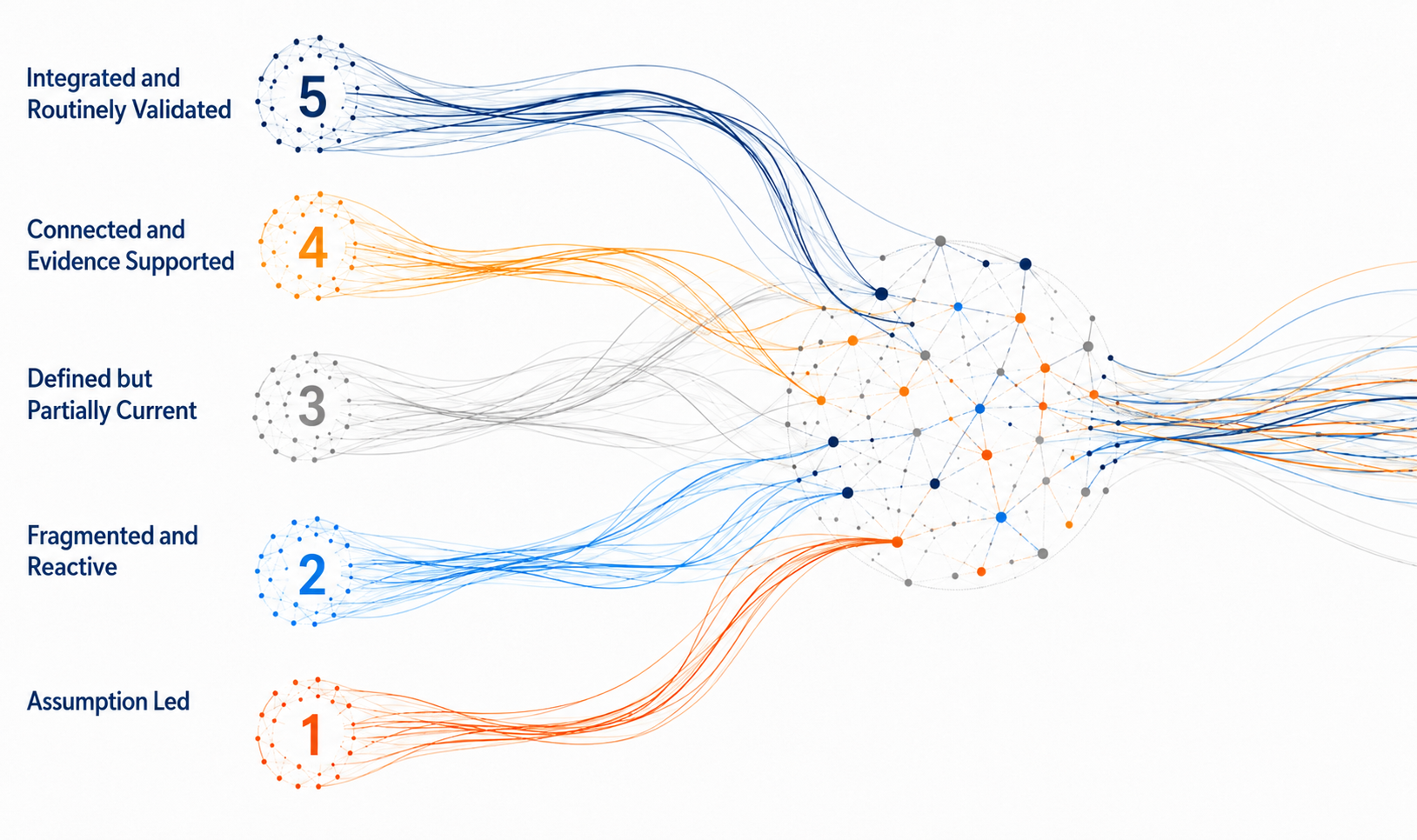
The Baseline Assessment assesses each area against a five-level maturity model
The Baseline Assessment scores each area against a five-level maturity model.
The aim isn't a generic score or a label of good or bad. It's a clear pattern across the model: where oversight is reliable, where it's exposed, and where leadership may be relying on outdated knowledge, informal judgement or incomplete evidence rather than current fact.
The result is a single overall score, plus individual scores across all ten categories, giving leadership a benchmarked view of exactly where oversight is strong and where it needs attention.
What you receive
A scored position, a live walkthrough, and a defensible case, not a document left to interpret alone.
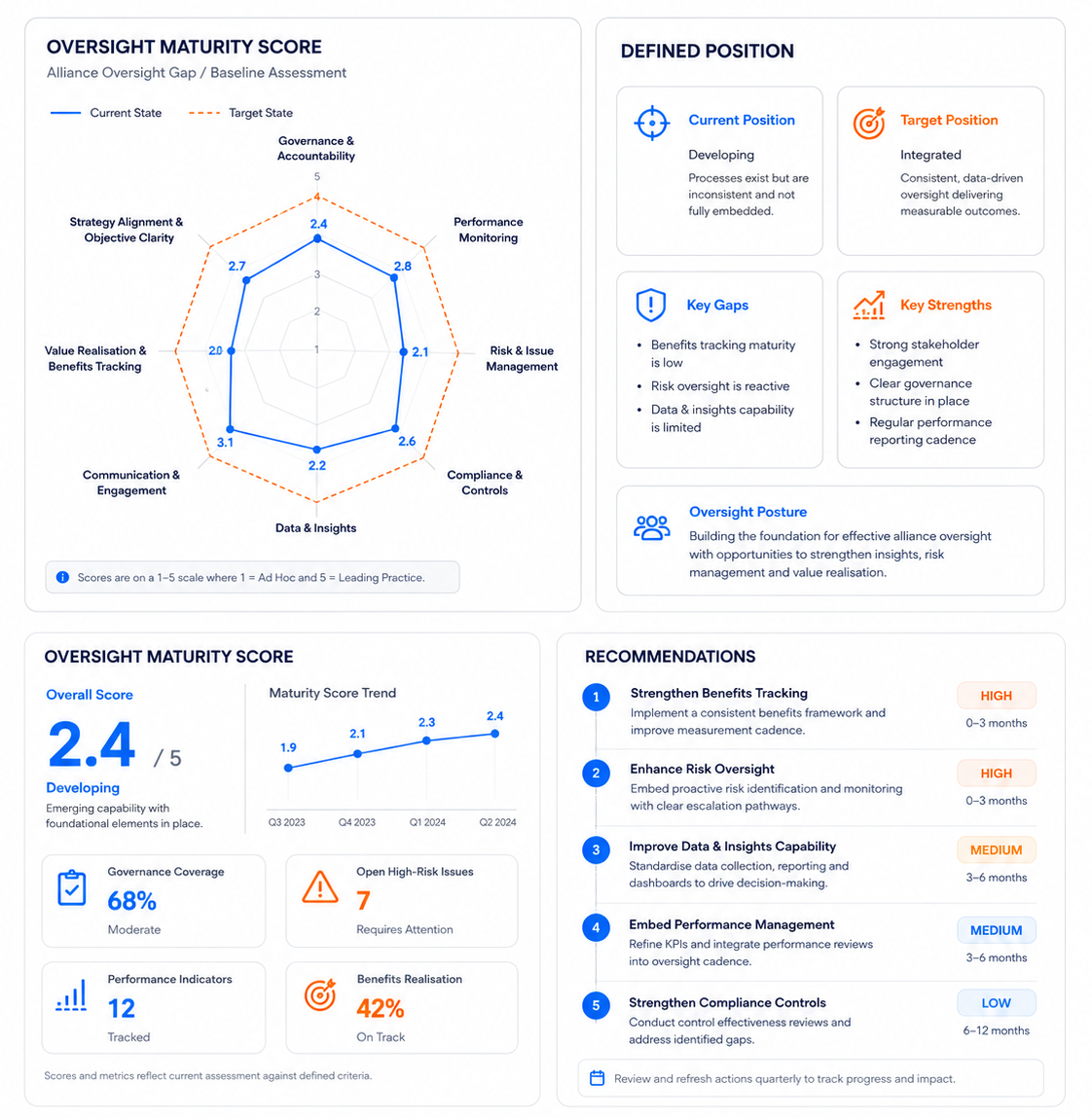
A complete position across all ten conditions: Your current position against all ten oversight conditions, shown both in writing and visually, a maturity score for each condition, a heatmap showing where exposure is concentrated, and an overall classification from Historical and Assumption Led through to Integrated and Routinely Validated, so the position is clear at a glance before the detail behind it is read.
A 60-minute session: A direct walkthrough of the findings with you, not a document left to interpret alone. This is where the evidence gets discussed, questioned, and properly understood before it goes anywhere else.
Evidence you can take upward: Findings are stated plainly and structured so they can be handed to your own leadership without further translation, a defensible case, not an internal working document.
A named, prioritised diagnosis: Where risk exists, it's identified specifically, which conditions are exposed, how serious each one is, and which matter most. Not a generic scorecard, a clear account of what's actually happening in this relationship.
A route to what's next: Where the assessment identifies risk worth acting on, you leave with a defined next step, a costed proposal scoped to exactly what was found, not a standard package.
Configured Around Your Alliance Environment
One consistent model, configured to your actual alliance environment.
The maturity model itself never changes, that's what makes results comparable across categories, respondents and time. What changes is where it's pointed: strategic alliances, technology partnerships, channel relationships, partner portfolios, joint ventures, or a single area of concern, configured around whichever alliances, stakeholders and questions matter most to your organisation.
Who should take part
Up to five leadership respondents, one shared framework, one comparable result.
Typically an executive sponsor, an alliance or partnerships leader, a commercial leader, an operational lead, and a finance or governance lead. Each completes the same structured assessment, so answers are analysed together rather than compared informally afterward, revealing where leadership shares a genuine, evidenced understanding, and where it separates: governance understood differently, risks visible to one function but not another, confidence running ahead of evidence.
The result is a more complete view than any single interview, workshop, or individual perspective could provide.
What this is, and isn't
A fixed-scope, fixed-price executive review, not a quiz, an audit, or a generic score.
It isn't designed to prove something is wrong, and it doesn't assume a gap already exists. The objective is to answer one question: does the organisation have enough current, reliable evidence to trust its view of alliance maturity, or is deeper investigation needed? Everything else, including whether further work is justified, is decided from that answer.